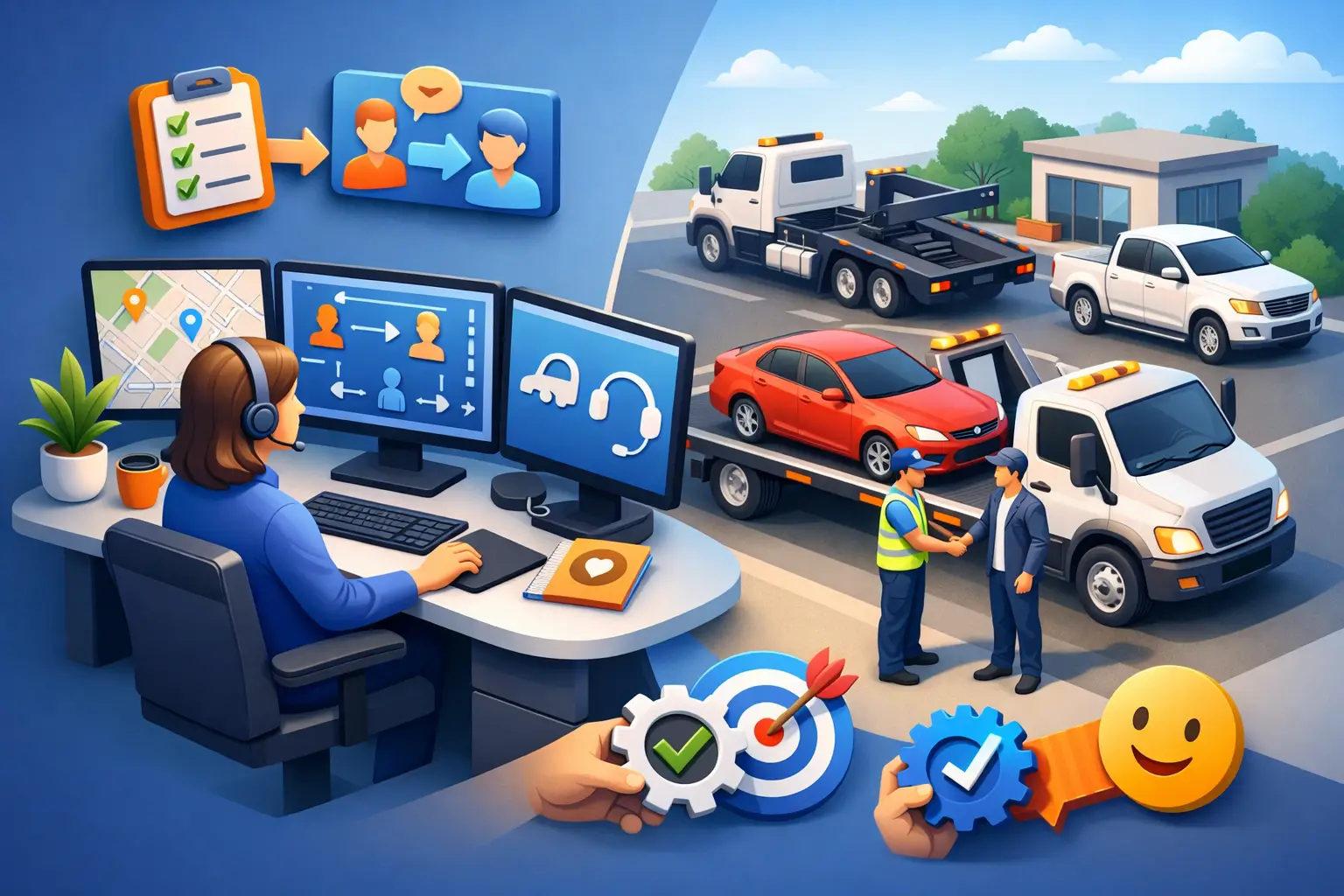
A dispatcher quits at 4:30 p.m. on a Friday, and the real cost starts before the replacement job post goes live. Calls stack up, drivers lose clear direction, motor club updates fall behind, and the person covering the board is forced to learn your operation during its busiest hours. Towing dispatcher turnover solutions need to protect the operation first, not just make hiring easier.
For towing companies, dispatch is not a generic office function. It is the control center for roadside calls, impound releases, police rotation work, driver availability, estimated arrival times, customer complaints, and Towbook job accuracy. When experienced dispatchers leave, they take operating knowledge with them: which accounts require special handling, which lots have access rules, how to route a heavy-duty request, and when a call needs immediate escalation.
The answer is rarely to find one perfect dispatcher and hope they stay forever. Better results come from building a dispatch model that documents knowledge, reduces repetitive workload, creates coverage, and keeps management in control when staffing changes.
Why dispatcher turnover hits towing companies harder
A vacant dispatch seat creates more than a payroll problem. A missed call can mean a lost cash tow, a frustrated motor club customer, or a stranded motorist who calls the next company on the search results. A job entered incorrectly can send the wrong truck, delay a release, or produce an avoidable billing dispute.
Turnover also puts pressure on the people who remain. Your best dispatcher may start covering nights, weekends, and lunch breaks. A manager gets pulled from sales, fleet maintenance, or customer relationships to answer phones. Drivers begin making decisions that should be handled from the board. That temporary scramble often becomes the normal operating model, which makes the next resignation more likely.
There is also a training issue. A new dispatcher can learn how to answer a phone quickly. Learning your actual operation takes longer. They need to understand service territories, equipment limits, storage rules, account preferences, local terminology, pricing boundaries, and how work should flow through Towbook. If the knowledge lives only in the head of the person who resigned, every new hire starts from zero.
Build towing dispatcher turnover solutions around coverage
The first priority is not filling an open position. It is ensuring that every call has a defined path to a capable answer, every job reaches the right workflow, and exceptions have a clear escalation route.
Start by mapping the calls your team handles in a normal week. Separate roadside assistance requests, police and municipal calls, impound inquiries, motor club dispatches, private-property towing, release questions, payment issues, and complaint calls. Each category should have a documented intake flow: the information required, the questions to ask, the job type to create, the routing rule, and the point where a manager or senior dispatcher must step in.
This process work can feel slow when the phones are already ringing. But it is what turns dispatch from a person-dependent function into an operating system. A new team member should not have to guess whether a caller needs a service request, a storage-lot answer, or an urgent driver update.
Put critical knowledge where the next person can use it
A thick binder nobody opens is not a dispatch system. Use short, practical instructions tied to actual scenarios. Document the most frequent call types, then the highest-risk exceptions. Include scripts or prompts for gathering vehicle details, location information, callback numbers, destination requirements, vehicle condition, account authorization, and payment expectations.
Keep account-specific rules current. If a motor club, police agency, body shop, property manager, or fleet customer has a different workflow, that information needs to be visible during the call. The same applies to driver assignment rules. A dispatcher should be able to see who can handle heavy-duty work, locked vehicles, accident recovery, long-distance transport, or storage-lot releases without relying on memory.
Towbook discipline matters here. When dispatch notes, statuses, and job details are entered consistently, your operation becomes easier to hand off. When information is kept in text messages, personal notebooks, and verbal instructions, turnover creates blind spots immediately.
Separate call capture from exception handling
Not every incoming call requires the same level of judgment. A large share of calls follow repeatable patterns. They need a fast answer, accurate information capture, correct job creation, and a defined route to the right driver or queue. Those steps are ideal for standardized workflows and AI-supported call handling.
The trade-off is clear: automation should not be asked to improvise around unusual recovery situations, upset customers, complicated billing disputes, or sensitive complaints. Those calls need trained human judgment and a clean escalation path. The goal is not to remove people from dispatch. It is to stop skilled people from spending their shift repeating the same intake questions while urgent exceptions wait.
A hybrid model gives operators more protection during turnover. Always-on call answering can capture routine demand after hours or during peak periods, while towing-trained dispatch support handles the situations that require operational context. That creates continuity without forcing one in-house dispatcher to be available every hour of every day.
Reduce the reasons good dispatchers leave
Coverage protects the company when turnover happens. It does not eliminate the reasons employees walk out. Dispatchers commonly leave because the role feels chaotic, understaffed, unsupported, or impossible to perform well.
Look closely at the workload rather than assuming pay is the only issue. If dispatchers spend half their shift answering repetitive status calls, explaining storage-lot procedures, manually reentering information, and tracking down drivers for basic updates, they have little room to do the work that actually requires judgment. That is a recipe for errors and burnout.
Give dispatchers clear authority boundaries. They should know which price questions they can answer, when they can reassign a truck, when they need approval, and who owns an escalated complaint. Ambiguity creates stress because every decision feels risky. Clear routing rules reduce that pressure while preserving management oversight.
Scheduling matters too. A company that relies on one person for nights, weekends, and every emergency is not operating efficiently, even if that person appears dependable. Rotating coverage, defined after-hours procedures, and external backup options are less expensive than constant churn, overtime, and missed revenue.
Use metrics to find the actual failure point
Turnover is often blamed on an employee when the real issue is a broken workflow. Track the numbers that show where dispatch is under strain: abandoned or missed calls, average answer time, jobs entered with incomplete information, dispatch-to-driver assignment time, after-hours call capture, repeat caller volume, customer complaints, and overtime hours.
Then compare performance by shift and call type. If overnight calls are missed but daytime performance is stable, the solution may be after-hours coverage rather than another full-time hire. If dispatchers are overwhelmed by impound and release inquiries, a defined intake process and better information access may solve more than adding another person to the phones.
This is where towing-specific outsourced dispatch can be useful. Towing Forward, for example, combines AI voice handling with trained dispatch support and Towbook-integrated workflows so calls can be answered, classified, routed, and documented according to the company’s rules. For an operator, the value is not outsourcing control. It is creating dependable coverage while maintaining visibility into how work moves through the board.
Make the transition plan part of normal operations
Do not wait for a resignation to decide how coverage will work. Every towing company should have a dispatch continuity plan that identifies who can approve exceptions, where key account instructions live, how calls are handled after hours, and what happens when a primary dispatcher is unavailable without notice.
Cross-training helps, but it should be realistic. An owner or office manager may be able to handle basic overflow for an hour. That does not mean they can run a complex dispatch board while performing their regular job. Build backup around the level of volume and complexity your company actually handles.
The strongest operations treat turnover as a systems test. If one employee leaving causes missed calls, stalled jobs, and driver confusion, the issue is not only staffing. It is that too much of the operating system was held by one person. Build coverage before the next departure, and dispatch can remain fast, accountable, and profitable even when the roster changes.
Learn more about Employee Turnover here
Make an appointment to learn more about Towing Forward here
Leave a Reply