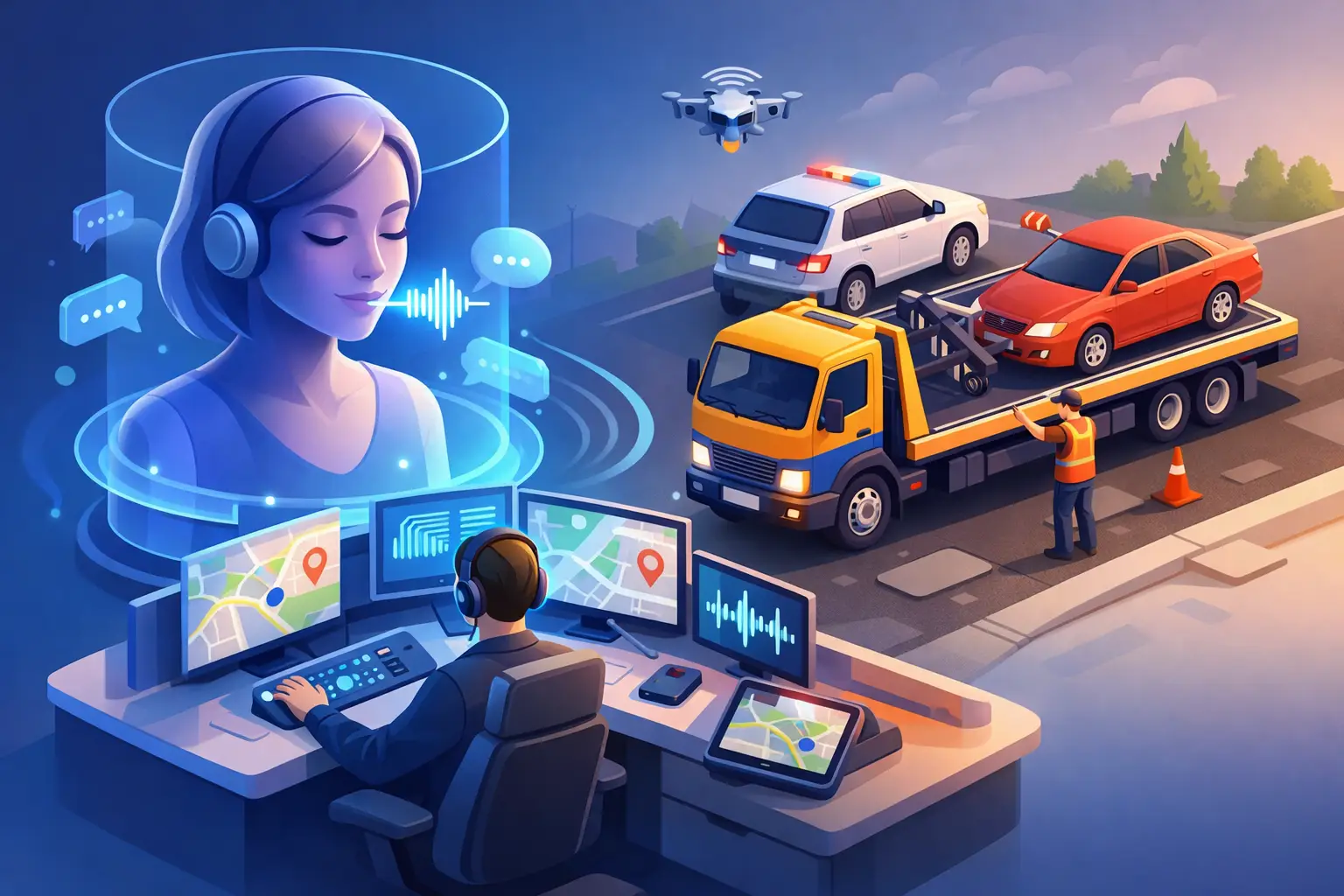
At 2:13 a.m., the problem usually is not truck availability. It is call handling. A stranded driver, a police impound request, or a motor club update comes in, and if nobody answers fast and captures the job correctly, revenue disappears before a truck ever rolls. That is why ai voice dispatch for towing is getting serious attention from operators who are tired of missed calls, expensive overnight staffing, and dispatch bottlenecks that start at the first ring.
For towing companies, phone coverage is not just a customer service issue. It is an operational control issue. Every unanswered call can mean a lost roadside job, a delayed impound release, a frustrated property manager, or a compliance headache. The promise of AI is not that it magically runs your business. The real value is tighter intake, faster routing, and more consistent call handling when your team is stretched thin.
What ai voice dispatch for towing actually does
A lot of operators hear the phrase and picture a generic voice bot that traps callers in menus and creates more problems than it solves. That is not the standard worth paying for. Effective ai voice dispatch for towing should answer calls immediately, understand the type of request, collect the right details, follow routing rules, and move the call or job to the right destination without slowing the process down.
In towing, that means handling real-world scenarios correctly. A release inquiry is not the same as a roadside service request. A police-generated tow has different urgency and documentation needs than a cash call from a disabled vehicle on the shoulder. A complaint call should not follow the same path as a dispatchable job. If the system cannot separate those situations early, it creates noise instead of efficiency.
The strongest setups also do more than answer the phone. They connect intake to dispatch workflow. If your operation runs in Towbook or another structured dispatch system, the point is not just conversation. The point is turning a call into usable job data with less manual re-entry and fewer handoff mistakes.
Why towing companies are looking at AI now
The pressure is coming from basic economics. Labor is expensive, overnight coverage is hard to staff, and dispatcher turnover creates inconsistency where consistency matters most. At the same time, customers expect immediate response, motor clubs track performance closely, and every lost call has a direct cost.
For many towing businesses, the old model is breaking down in predictable ways. Daytime phones get overloaded during spikes. Nights and weekends rely on whoever is available. Office staff loses time repeating the same intake questions. Dispatchers spend too much energy sorting simple calls instead of managing active jobs and driver status.
AI can fix part of that, but only if it is built around towing operations. Generic call answering software may work for appointment-based businesses. Towing is different. It is event-driven, time-sensitive, and often chaotic. Callers may be stressed, uncertain about their location, or calling from a roadside shoulder with poor audio. The dispatch layer has to be designed for that reality.
Where AI voice dispatch delivers the biggest operational gains
The first win is call capture. If your phones are not answered consistently, no improvement downstream matters much. A system that answers every call, especially after hours, protects revenue before it protects efficiency.
The second win is intake speed. When the initial information is gathered in a consistent format, dispatchers spend less time chasing basics and more time making decisions. That matters in high-volume roadside work, but it also matters in impounds, where one wrong detail can create delays and unhappy customers at the yard.
The third win is cost control. A fully staffed in-house phone team around the clock is expensive. Most operators do not need identical labor coverage at every hour. They need reliable coverage at every hour. There is a difference. AI-supported voice dispatch gives companies a way to maintain responsiveness without carrying full overnight staffing costs just to protect against missed calls.
There is also a less obvious gain: process discipline. Many towing businesses own capable software but still run critical intake steps through memory, paper notes, or disconnected text threads. AI exposes weak process design quickly. If routing rules are clear, escalation paths are defined, and dispatch categories are standardized, the operation gets faster. If those things are messy, AI will not hide it. That is a good thing if you want better control.
The trade-off: automation helps, but only to a point
This is where operators need a clear-eyed view. Not every towing call should stay fully automated from start to finish. Some situations require judgment, de-escalation, or company-specific policy decisions.
A motorist asking for a basic tire change is one thing. A property owner disputing a tow, a customer threatening legal action, or a law enforcement agency with special instructions is another. Good dispatch design recognizes that difference. The goal is not to automate every conversation. The goal is to automate the repeatable parts and escalate the rest cleanly.
That is why hybrid models tend to outperform pure automation in towing. AI handles immediate answer rates, structured intake, and routine call sorting. Human dispatch support steps in where nuance, exceptions, or customer management matter. This gives operators speed without giving up oversight.
For many companies, that balance is the deciding factor. They do not want a flashy demo. They want to know who handles the hard calls, how routing works after hours, what gets entered into the system, and who is accountable when a call does not fit a script.
How to evaluate ai voice dispatch for towing
If you are considering a solution, the first question is not whether the voice sounds natural. That matters, but it is not the main thing. The real question is whether the system understands towing workflows well enough to reduce friction instead of adding another layer.
Start with scenario handling. Ask how the service deals with roadside assistance, impound questions, police calls, storage release inquiries, ETA checks, complaints, and motor club interactions. If every answer sounds generic, the provider probably is.
Then look at workflow integration. If calls are answered well but details still have to be retyped manually into your dispatch platform, you are only solving half the problem. Towing operations get leverage when intake, routing, and data entry are connected.
Routing logic matters just as much. Different call types should go to different places based on time of day, service line, geography, priority, and escalation rules. A serious setup should be able to reflect how your company actually runs, not force you into a one-size-fits-all phone tree.
You should also ask about visibility. Can you see what happened on each call? Can your team review intake quality, outcomes, and exceptions? Can routing rules be adjusted as your operation changes? If not, you may be trading one blind spot for another.
What implementation looks like in practice
Most towing companies do not need a massive transition. They need a clean rollout with well-defined call types, escalation paths, and software rules. In practice, implementation usually starts with mapping your most common inbound scenarios and deciding what should be automated, what should be routed, and what should always go to a human.
That process often reveals easy wins. Maybe after-hours release inquiries can be handled with structured information capture and callback routing. Maybe motor club overflow can be answered immediately instead of stacking up in voicemail. Maybe office staff can stop fielding repetitive status calls and focus on active dispatch management.
The important part is that deployment should match your operation, not an abstract AI playbook. A small two-truck company with heavy after-hours roadside volume has different needs than a multi-location operator managing impounds, municipal contracts, and private property towing. The right model depends on call volume, software maturity, staffing gaps, and how much process variation you already have.
This is where a towing-specific partner has an edge. Towing Forward, for example, is built around the actual call patterns and dispatch demands towing companies deal with every day, not a generic customer service script.
The real standard is control, not novelty
There is a lot of noise around AI right now, and towing companies should be skeptical. The point is not to sound innovative. The point is to answer more calls, enter better data, route work faster, and protect margin.
If ai voice dispatch for towing gives you those results, it is worth serious consideration. If it only gives you a nicer phone greeting, it is not. Operators do not need more tech for its own sake. They need dispatch infrastructure that holds up at 2:13 a.m., during lunch rush, during storm spikes, and during the ugly edge cases that define this business.
The best systems do not replace operational discipline. They reinforce it. And when your phones are answered, your jobs are captured, and your dispatch team is not buried in avoidable call volume, the whole business runs tighter.
Learn more about Towing Forward Company Here
Try a demo Here
Learn what it is like to work with us Here

Leave a Reply