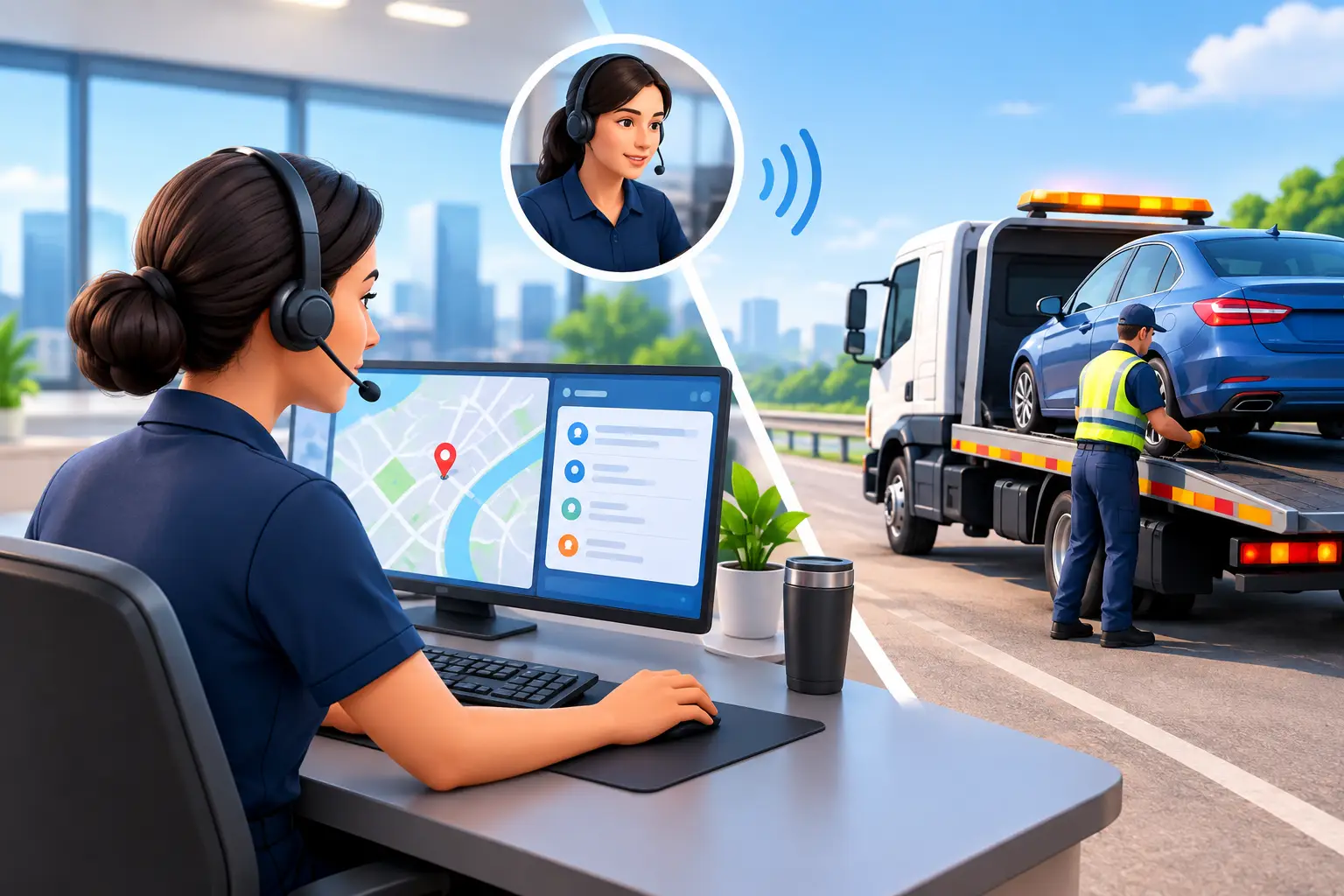
A 2:13 a.m. roadside call does not care whether the dispatcher is sitting in your office, working from a remote operations center, or supported by AI. The caller needs a clear answer, the driver needs correct location and vehicle details, and your company needs the job entered, routed, and tracked without delay. That is the real test behind the question: are remote dispatchers reliable for towing companies?
They can be. But reliability is not created by putting a headset in a different building. It comes from towing-specific training, disciplined call flows, direct access to the dispatch system, clear escalation rules, and accountability for every call that enters the business. A remote dispatcher with those controls can outperform an understaffed in-house night shift. A generic answering service with no towing workflow usually cannot.
Are Remote Dispatchers Reliable? It Depends on the Operation
Remote dispatch is reliable when it functions as an extension of your operation, not as a message-taking service. That distinction matters. A caller who says, “My car is on the shoulder near the exit” has not provided enough information to dispatch safely. The dispatcher must confirm the roadway, direction of travel, mile marker or landmark, vehicle type, condition, destination, payment or motor club details, and any safety concern before a truck is assigned.
The same standard applies to impound calls, release questions, police rotations, private property tows, accident scenes, and motor club work. Each call type has different information requirements and different consequences when the details are wrong. A missed VIN digit, incorrect lot hours, or failure to identify a low-clearance vehicle can create a costly second call, a frustrated customer, or a driver sent to the wrong job.
The location of the dispatcher is secondary. Process discipline is primary.
For many towing companies, remote coverage is most valuable outside normal office hours, during call spikes, and when a dispatcher calls out. Those are also the moments when a weak remote model is exposed. If the provider cannot see job status, cannot communicate with drivers, or has no defined path for exceptions, the owner becomes the fallback dispatcher. That is not outsourced dispatch. It is outsourced inconvenience.
What Makes a Remote Dispatch Team Dependable
Towing-specific call handling
A reliable remote team understands that towing calls are not interchangeable with HVAC, medical offices, or general customer service. The language, urgency, and decision points are different. Dispatchers need to know how to separate an impound inquiry from a roadside request, how to identify a motor club authorization issue, and when a complaint needs immediate escalation instead of a scripted response.
They also need to ask questions in the right order. When a driver is available, speed matters. When a customer is stranded on an active roadway, safety and precise location matter more. When a vehicle is in storage, accurate policy communication matters. Training should reflect those realities, not rely on generic call-center scripts.
Direct workflow visibility
Remote dispatchers should work inside the same operating environment as your internal team whenever possible. For companies using Towbook, that means calls, customer details, vehicle information, notes, job status, and routing rules should move through the platform rather than live in separate spreadsheets, email inboxes, or handwritten notes.
Visibility protects control. An owner or manager should be able to review what happened on a call, see when a job was created, confirm which driver was assigned, and identify whether a request required follow-up. If remote staff must send a recap after the fact for your team to re-enter, you have added delay and duplicate work at the exact point dispatch should be reducing both.
Clear routing and escalation rules
No dispatcher, remote or in-house, can make consistent decisions without defined operating rules. Your dispatch partner should know which calls go to which trucks, how to prioritize police or motor club work, when to transfer an upset customer, who approves exceptions, and what to do when the closest driver is unavailable.
Good routing rules are specific. They account for service area, truck capabilities, driver schedules, lot procedures, customer accounts, payment requirements, and after-hours contacts. They also leave room for human judgment when the situation does not fit the normal flow.
Measurable accountability
Reliability should be visible in the numbers, not promised in a sales conversation. Track call answer rate, abandoned calls, time to create a job, dispatch-to-arrival performance, data-entry errors, after-hours call capture, and the number of calls that require owner intervention.
A remote dispatch partner should also provide a way to review exceptions. If jobs are repeatedly missing destination details or drivers are receiving incomplete notes, the problem needs to be identified and corrected quickly. Consistency is built through monitoring, coaching, and operational review.
Where Remote Dispatch Can Break Down
Remote dispatch is not automatically the right answer for every company or every shift. The most common failures come from a poor handoff between the towing company and the remote team.
First, some operators outsource before documenting their own process. If your rules for impound releases, service areas, pricing, customer accounts, or driver assignment exist only in one manager’s memory, remote staff will be forced to guess. That produces inconsistency, even with capable dispatchers.
Second, a remote provider may have limited authority or limited system access. A dispatcher who can answer the phone but cannot create a job, update notes, or see driver availability is operating with one hand tied behind their back. The caller experiences delay, and your office inherits the cleanup.
Third, technology can create false confidence. AI voice systems can capture calls quickly, collect structured information, and prevent routine calls from going unanswered. But they need carefully designed prompts, accurate business rules, and a human support path for complex or emotional situations. A caller disputing a tow, a police officer requesting immediate service, or a stranded family with unclear location may require trained human judgment.
The practical answer is often a hybrid model: AI handles immediate answering and routine information capture, while towing-trained people take over when the call requires judgment, exception handling, or direct coordination. That approach can extend coverage without treating every call like a simple transaction.
How to Evaluate a Remote Dispatch Provider
Before moving calls offsite, test the provider against the work that actually drives your business. Ask them to explain how they would handle an after-hours impound release inquiry, a motor club call with incomplete location information, a multi-vehicle accident request, and a customer complaint about ETA. Vague answers are a warning sign.
Look for evidence in five areas:
- Towing-industry training, not broad call-center experience alone
- Live access to your dispatch workflow and job notes
- Custom routing, escalation, and after-hours procedures
- Call recording or quality review with clear reporting
- A defined human support path when automation cannot resolve the call
You should also ask what happens during high volume. Reliability is not measured on a quiet Tuesday afternoon. It is measured when three roadside calls arrive at once, a driver is delayed, a motor club request needs attention, and your office is closed. The provider should be able to explain staffing coverage, overflow procedures, escalation timing, and how your team retains visibility throughout the event.
A pilot period is often the smartest way to validate performance. Start with after-hours calls, overflow coverage, or a defined call category. Establish baseline metrics before the change, review real call outcomes weekly, and adjust routing rules based on what the operation shows. This lets you improve the process without handing over control blindly.
Reliability Is a System, Not a Staffing Location
The strongest remote dispatch setup does not ask owners to choose between automation and human judgment. It uses both where each is most effective. AI can answer immediately, capture repeatable details, and route calls according to rules. Experienced towing dispatchers can handle the exceptions that protect customer experience, driver productivity, and company reputation.
That is the operating model Towing Forward is built around: towing-specific call handling, custom workflows, and Towbook-connected visibility designed for real dispatch conditions. The goal is not simply to move phones away from your office. It is to reduce missed calls while keeping the information, decisions, and accountability that make a towing operation run.
The best next step is simple: map the calls your team handles after hours, identify where information is lost or response time slows down, and require any remote solution to prove it can improve those points without taking away your operational control.
Leave a Reply