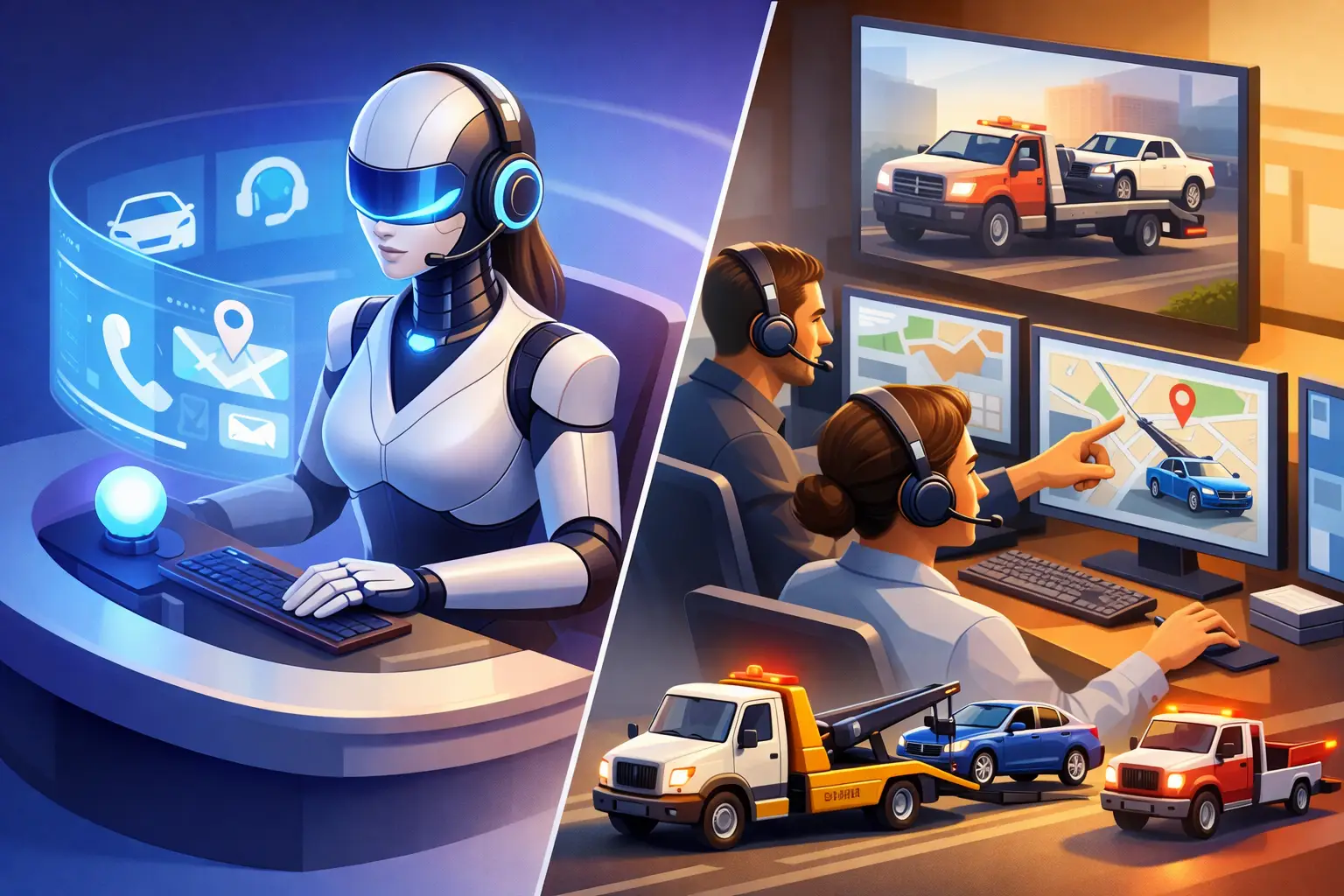
A phone rings at 2:13 a.m. It may be a stranded driver, a motor club assignment, an impound customer who needs answers, or a police agency requesting a rotation response. In that moment, the AI receptionist vs dispatch team question is not about technology preferences. It is about whether the call is answered, the information is captured correctly, and the right truck moves without creating a problem for the next shift.
For towing companies, dispatch is not a generic call-center function. It involves location details, vehicle conditions, storage-lot policies, service-area boundaries, motor club procedures, Towbook status updates, and judgment calls that can affect revenue, compliance, and customer trust. The right model depends on the work your operation handles, when calls arrive, and how much control your current team has over the queue.
AI Receptionist vs Dispatch Team: The Real Difference
An AI receptionist is built to answer calls immediately, gather structured information, respond to common questions, and route or create work according to predefined rules. A dispatch team is responsible for interpreting the situation, assigning resources, communicating with drivers, updating job status, and handling exceptions that do not fit a standard script.
Those are different jobs, even though many towing companies have historically placed both responsibilities on one dispatcher. When a busy dispatcher is on the phone, they may not be watching truck availability. When they are coordinating a difficult recovery, the next caller may go to voicemail. That is where revenue leaks out.
AI is strongest at consistency and speed. It can answer every inbound call, collect the caller’s name, callback number, pickup location, destination, vehicle information, and service request. It does not call out sick, need a meal break, or become overwhelmed when several calls arrive at once. For after-hours and overflow coverage, that reliability can materially improve call capture.
A trained dispatch team is strongest where context matters. A customer may be upset about an impounded vehicle. A motor club call may have incomplete or conflicting details. A driver may be tied up longer than expected, changing the best assignment decision. Human dispatchers can assess the situation, clarify what matters, and make operational choices that rules alone should not make.
The mistake is treating this as an all-or-nothing replacement decision. For many towing operations, the best answer is a hybrid: AI handles immediate answering and structured intake, while towing-specific dispatch professionals take over exceptions, sensitive calls, and active fleet coordination.
Where an AI Receptionist Produces Fast Value
The first operational win is fewer missed calls. If your office phones roll to voicemail during peak periods, after business hours, or while dispatchers are working active jobs, every unanswered ring can represent lost revenue or a damaged customer relationship. An AI receptionist provides a reliable first response regardless of time or call volume.
It also brings discipline to intake. Calls can be handled using your routing rules: which ZIP codes you serve, which jobs require human escalation, how motor club requests are categorized, where impound inquiries go, and what information must be collected before a dispatch record is created. This reduces the incomplete notes and repeated callbacks that slow down a shift.
For companies using Towbook, the value increases when intake is connected to the actual workflow. A call should not simply produce a message for someone to read later. The goal is for the correct job details to enter the dispatch process in a usable format, with clear visibility into what was requested and what action is required.
AI is particularly useful for common, repeatable call types, including roadside service requests, basic ETA inquiries, after-hours customer calls, and initial impound questions. It can also identify calls that need immediate escalation rather than forcing every caller through the same path.
That said, an AI receptionist is only as useful as its configuration. Generic prompts and vague handoff rules create more work, not less. Towing operations need service-area rules, terminology, escalation triggers, and call flows built around real field conditions.
Where a Dispatch Team Still Matters Most
Dispatching is more than entering an address and assigning the nearest truck. The closest truck may be the wrong truck. A flatbed may be needed for a low-clearance vehicle. A heavy-duty unit may be committed on a recovery. A driver may know a particular property has difficult access, a police rotation may require a specific response, or a storage release may involve documentation that cannot be handled with a standard answer.
A capable dispatch team maintains the operating picture. They monitor driver availability, job aging, priority changes, customer callbacks, and the details that determine whether a promised ETA is realistic. They can also coordinate during a surge, deciding what must move first and what needs to be communicated clearly to avoid escalation.
Human coverage is especially valuable for complaint handling, unusual impound situations, disputes, multi-vehicle incidents, complex recoveries, and high-value accounts. These calls require judgment and accountability, not just a fast response.
The staffing challenge is that maintaining this level of coverage around the clock is expensive. Overnight dispatch shifts can be difficult to fill. Turnover creates training costs and process inconsistency. Small and mid-sized fleets may not have enough overnight volume to justify a fully staffed in-house desk, yet they cannot afford to miss emergency calls.
That is why outsourcing can make sense when it is specialized. A general answering service may answer the phone, but it may not understand motor club requirements, impound workflows, or what information a towing dispatcher needs before rolling a truck.
Cost Is More Than Payroll
When comparing an AI receptionist with a dispatch team, payroll is the obvious line item. It is not the only one that matters.
A fully in-house dispatch model includes wages, overtime, benefits, training, turnover, supervision, and the cost of coverage gaps. It also includes the hidden cost of calls missed while a dispatcher is occupied. If your team is strong during daytime hours but inconsistent overnight, the real question is not whether dispatch has a cost. It is whether the current cost produces reliable coverage.
AI usually costs less per handled call and scales better during volume spikes. But it should not be evaluated solely as a cheaper voice on the phone. Its business value comes from captured jobs, faster intake, cleaner data, and less interruption for dispatchers managing the fleet.
A human dispatch team costs more because it performs higher-value work. The best use of that labor is not repeatedly collecting basic caller information. It is making decisions, solving exceptions, protecting major accounts, and keeping trucks productive.
Measure the model against operational outcomes: answer rate, abandoned-call rate, time to create a job, dispatch-to-en-route time, jobs lost to voicemail, after-hours revenue, customer callbacks, and driver utilization. If the technology or staffing model cannot improve one or more of those numbers, it is not solving the real problem.
The Hybrid Model Gives Operators More Control
A hybrid workflow separates call capture from dispatch judgment without creating a disconnect between the two. AI answers immediately and follows your approved intake and routing rules. Straightforward calls are documented and moved into the workflow. Calls involving exceptions, urgent issues, or sensitive customer situations are escalated to trained humans.
This model also allows your in-house team to retain control where it matters. You define service areas, preferred truck types, escalation criteria, business hours, impound policies, and call-routing priorities. The system works around your operation rather than forcing your operation into a generic template.
For example, an after-hours roadside caller can receive an immediate response and provide all required job details. If the request is within your service area and meets your standard criteria, it can move forward quickly. If the caller is requesting an impound release, disputing charges, or reporting an unsafe situation, the call can be routed to a human who understands the appropriate next step.
Towing Forward applies this approach through AI-powered answering, towing-specific human support, and Towbook-integrated workflows. The objective is not to remove accountability from dispatch. It is to eliminate avoidable missed calls and repetitive intake work while preserving the operational judgment a real towing business requires.
How to Decide What Your Fleet Needs
Start with your call patterns. If missed calls occur mostly at night, during lunch coverage, or when multiple phones ring at once, immediate AI answering may address the largest gap. If your primary issue is driver coordination, stale job statuses, or poor ETA management, you likely need stronger dispatch process support, not just call answering.
Then look at the type of work you handle. A straightforward roadside-heavy operation can automate more of its front-end intake than a company with complex police rotation, impound, heavy-duty, and recovery work. That does not mean complex fleets cannot use AI. It means their escalation rules need to be tighter and their human support more involved.
Finally, audit your current workflow. Listen to missed-call voicemails. Review incomplete jobs. Find out how often dispatchers re-enter information, call customers back for addresses, or lose time answering questions that could have been handled through a defined call flow. Those are the places where automation can create immediate capacity.
The goal is not to choose between a machine and a person. Build a dispatch operation where every call is answered, every job enters the right workflow, and your people spend their time on decisions that keep trucks moving and customers informed.
Leave a Reply