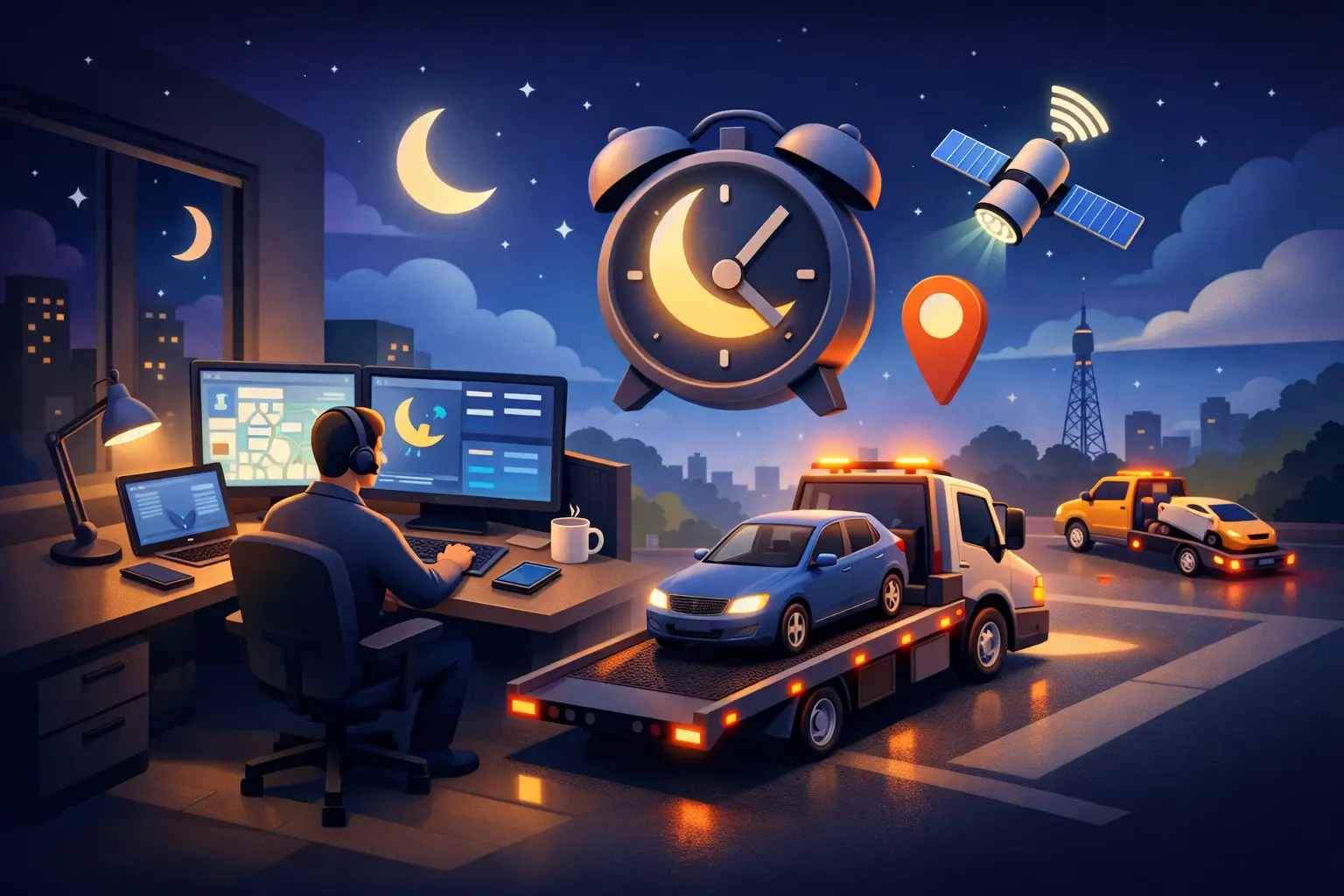
At 2:17 a.m., the problem usually is not call volume. It is what happens when one impound release, one motor club call, one police rotation request, and one angry customer all hit at once while your night coverage is thin. That is where overnight dispatch for tow companies stops being a staffing question and becomes an operational control issue.
Most towing businesses do not lose money overnight because the phones are always ringing. They lose money because after-hours work is inconsistent, high-stakes, and easy to mishandle. A missed call can mean a lost tow. A slow intake can mean a late arrival. Bad data entry can create billing problems, customer complaints, and headaches for the morning shift. If your overnight process depends on one tired dispatcher, an owner answering calls from home, or a driver juggling both driving and intake, the risk is not theoretical. It shows up in margins, response times, and customer retention.
References
To see a short video about Towing forward, click here.
📅 Or book a quick demo by clicking here
Why overnight dispatch gets expensive fast
Overnight coverage looks simple from the outside. Keep the phones on, dispatch the driver, and get through the night. In practice, the cost comes from inconsistency.
Some nights are quiet enough that a full in-house overnight dispatcher feels underused. Other nights turn chaotic without warning. That creates a bad staffing equation. If you overstaff, labor costs climb and the shift may not justify itself. If you understaff, missed calls and poor call handling erase revenue faster than most owners realize.
There is also the experience gap. Overnight calls are not easier calls. They often include intoxicated customers, law enforcement requests, accident scenes, locked impound yards, complaint calls, and motor club jobs with strict data requirements. A generic answering service usually cannot manage those situations well. A general virtual receptionist may answer the phone, but if they cannot verify the right details, route the call correctly, and move the job into the dispatch workflow without friction, you still own the operational damage.
That is why overnight dispatch for tow companies needs to be measured by outcomes, not just phone coverage. Did the call get answered? Was the job qualified correctly? Did the right driver get dispatched fast? Did the information land in the right place for billing, compliance, and follow-up? If any of those fail, the cost of “coverage” is misleading.
What good overnight dispatch for tow companies actually does
A strong overnight dispatch function does more than prevent voicemail. It creates consistency when your internal oversight is lowest.
That starts with call handling. Every after-hours call needs a defined path based on call type, geography, service line, customer category, and urgency. Police rotation should not follow the same workflow as a private property impound question. A motor club call should not be handled like a cash roadside request. Complaint calls need a different tone and escalation path than a simple tire change.
From there, dispatch quality depends on speed and structure. The caller should not have to repeat everything twice. The dispatcher should know what details are required for the job type. Driver notifications should follow the right order. If a primary unit is unavailable, backup routing should already be defined. If the job belongs in Towbook, entry should be standardized so the morning team is not cleaning up incomplete tickets.
The best overnight systems also protect management time. Owners should not be the default overflow plan every time a call gets complicated. Exceptions should escalate only when they actually require management judgment. Everything else should follow rules that have already been set.
Where most after-hours setups break down
The weak point is rarely the phone itself. It is the handoff between answering and action.
A common setup is forwarding calls to a driver after hours. It feels efficient because there is no added payroll. But drivers are not sitting at a desk. They are fueling, hooking, unloading, dealing with law enforcement, or sleeping between jobs. Even when they answer, intake quality suffers because they are trying to work and collect details at the same time.
Another common setup is using office staff to rotate nights. That can work for a while, but it usually creates burnout, inconsistency, and turnover. Overnight dispatch requires a different cadence than daytime admin work. It is reactive, interruption-heavy, and often stressful because the margin for error is smaller.
Then there is the generic call center model. It solves availability but often misses context. If the person answering does not understand release procedures, storage issues, scene priorities, service areas, or motor club expectations, they become a message-taking layer instead of a dispatch function. That slows everything down and forces your team to redo work.
The hybrid model makes more sense after hours
For many towing companies, the best overnight model is a hybrid one: automation for speed and consistency, backed by towing-specific human support for judgment calls and exceptions.
That matters because overnight call handling has two competing demands. First, calls need to be answered immediately. Second, not every call fits a script. Some require clarification, de-escalation, or a routing decision based on your company rules.
An AI-supported intake layer can capture the call, identify the service type, collect required details, and trigger the right workflow quickly. But the value only holds if the system is built around towing operations, not generic contact center logic. It needs to know what makes a call dispatchable, what needs escalation, and how your actual business handles after-hours scenarios.
Human-supported dispatch still matters because towing is full of edge cases. A customer may not know their location. A vehicle may be blocked inside a garage. A police call may require immediate verification. An impound caller may be upset and confused. The right model uses automation to remove delay and repetitive intake work, while keeping experienced dispatch judgment available when the call demands it.
That is where a specialized partner has a real advantage. Towing Forward, for example, is built around towing-specific workflows rather than generic after-hours answering. That distinction matters more overnight than at any other time of day.
How to evaluate overnight dispatch without guessing
If you are considering a change, do not start with the question, “Do we need help answering the phones?” Start with where revenue and control are slipping after hours.
Look at missed calls first. Not just total volume, but what kind of calls are being missed and when. Then look at call-to-dispatch time. If your phones are being answered but jobs still sit too long before assignment, your issue is workflow, not availability.
Next, review ticket quality. Are after-hours jobs entered consistently? Are required fields completed? Is the morning team correcting notes, updating billing data, or calling customers back to fill gaps? Cleanup work is a hidden cost that makes a weak overnight setup look cheaper than it is.
You should also check escalation noise. How often is ownership getting pulled into routine issues? How often are drivers calling back for missing details? A good overnight dispatch process reduces interruptions for everyone except when a true exception occurs.
Finally, compare labor cost against captured revenue, not just headcount. A lower-cost overnight setup that misses two motor club calls, mishandles one police request, and creates four problem tickets may be more expensive than a higher-quality model with tighter controls.
What implementation should look like
A workable overnight dispatch transition is not just turning on call forwarding. It should start with routing rules, call types, service areas, escalation logic, and software workflow.
That means defining who handles what, what information is required by job type, how priority jobs are identified, when management gets involved, and how data enters your dispatch system. If you use Towbook, consistency here matters because after-hours sloppiness turns into day-shift rework very quickly.
It also means acknowledging trade-offs. Some companies need full overnight dispatch replacement. Others only need overflow coverage, weekend nights, or support during staffing gaps. Some want every call live-answered with immediate job creation. Others want certain call types screened or escalated differently. The right setup depends on your call mix, truck count, geography, and how much standardization already exists in your operation.
What should not vary is accountability. You should know how calls are being handled, how jobs are being routed, and where failures are occurring if they happen. Overnight dispatch should give you more visibility, not less.
The towing companies that get after-hours right are not necessarily the biggest. They are the ones that stop treating overnight as a side shift and start treating it as a controlled operating window. When your phones are covered, your workflows are defined, and your dispatch logic still holds at 3 a.m., the night shift stops draining margin and starts producing cleaner, more reliable revenue. That is usually the point where overnight stops feeling unpredictable and starts feeling manageable.
Leave a Reply