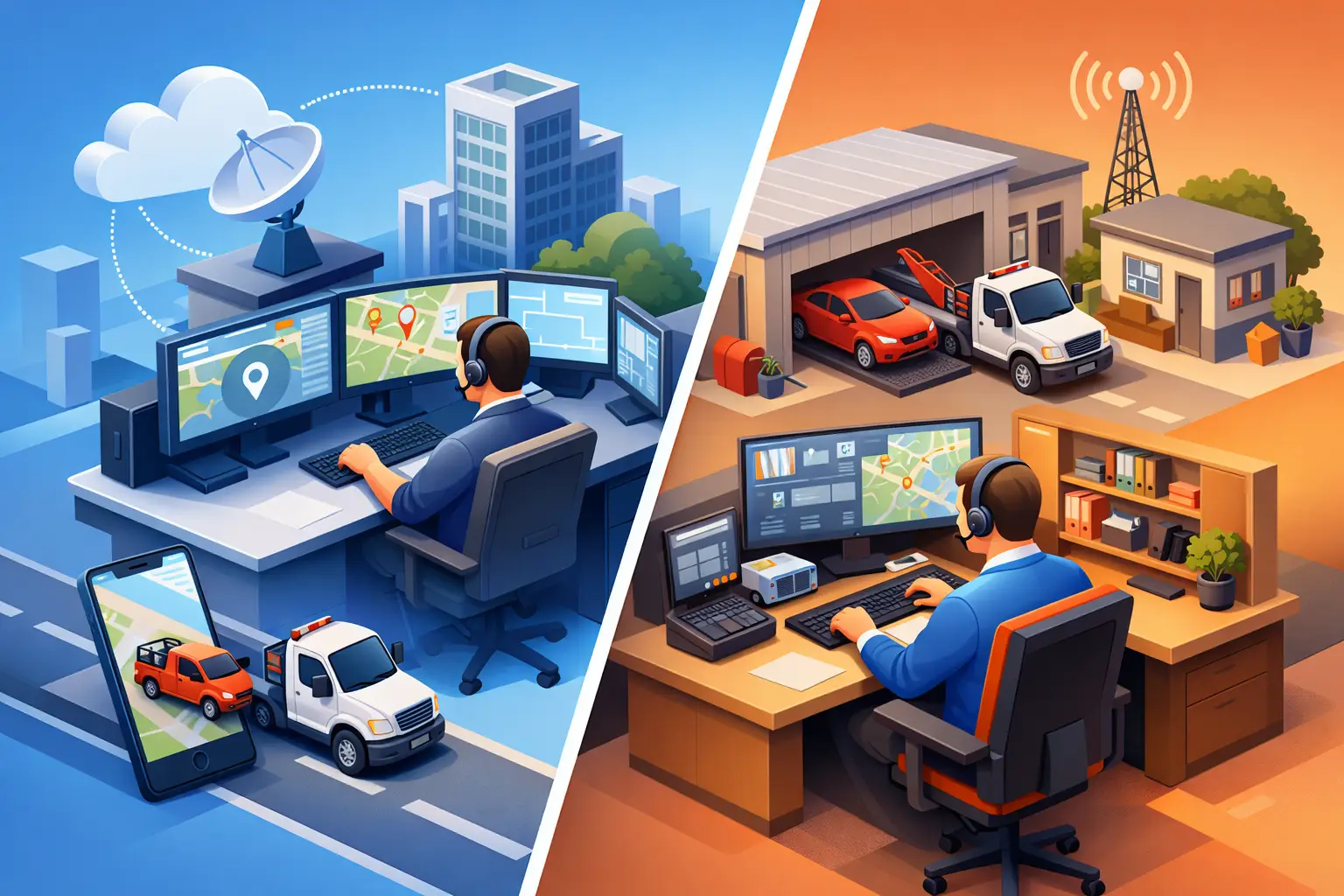
At 2:13 a.m., the question is not whether your dispatch model looks good on paper. The question is whether the call gets answered, the job gets entered correctly, and the right truck gets moving without delay. That is why outsourced dispatch vs in house is not a theoretical debate for towing companies. It is an operating decision that affects revenue, response times, labor cost, customer experience, and how much control you really have when the phones stay busy after hours.
For towing operators, dispatch is not just call taking. It is the control center for intake, routing, status updates, driver coordination, impound questions, motor club compliance, and the dozens of edge cases that show up in real towing work. If dispatch is inconsistent, everything downstream gets more expensive.
Outsourced dispatch vs in house: what actually changes
The biggest mistake owners make is treating this as a staffing question alone. It is really a systems question. In-house dispatch means you hire, train, schedule, supervise, and retain your own team. Outsourced dispatch means a third-party team handles some or all of that function using defined workflows, routing rules, and software processes.
On the surface, in-house feels simpler because the people are yours. You can walk into the office, hear calls, and make changes on the fly. That matters. In towing, direct control has real value, especially if your operation handles police rotation, impounds, specialty equipment, or local accounts with very specific expectations.
But control is not the same as performance. An in-house team can still miss calls, enter incomplete jobs, fail to update statuses, or struggle with nights and weekends. Outsourced dispatch can reduce those failures, but only if the provider understands towing operations at a practical level. Generic answering services do not solve towing dispatch problems. They usually create new ones.
Where in-house dispatch performs best
In-house dispatch works well when you have stable call volume, strong supervisors, low turnover, and enough scale to keep coverage consistent across all shifts. If your dispatchers know your drivers, your zones, your accounts, and your escalation rules, that familiarity can produce fast decisions and fewer handoff errors.
There is also a cultural advantage. Your internal team is immersed in your standards. They hear the same complaints, understand the pressure points, and can adapt quickly when your priorities change. If you are running a high-accountability operation with disciplined processes, in-house dispatch can be a strong asset.
The problem is that many towing companies are not comparing ideal in-house dispatch to outsourced dispatch. They are comparing outsourced dispatch to a stretched internal setup that depends on one or two key people, inconsistent after-hours coverage, and constant schedule patching. Once that happens, the cost of keeping dispatch internal starts showing up in missed calls, slower job intake, dispatcher burnout, and owner involvement that never really ends.
Where outsourced dispatch creates leverage
Outsourced dispatch makes the most sense when your current bottleneck is coverage, consistency, or cost per handled call. If nights, weekends, overflow, and vacation gaps are where performance breaks down, outsourcing can stabilize the operation fast.
That is especially true in towing because call demand is uneven. You might have quiet periods followed by clustered inbound activity from roadside calls, police requests, status checks, and impound inquiries. Staffing an internal desk for peak availability often means paying for underused labor during slower windows. Outsourced models can absorb that variability better if they are built correctly.
The leverage comes from standardization. A good outsourced dispatch operation does not rely on one strong employee carrying the load. It runs on defined call flows, account-specific instructions, software discipline, and documented escalation paths. When those pieces are in place, you get more predictable intake and fewer dropped balls.
That said, outsourcing is not automatically better. If the provider lacks towing-specific training, if they cannot work cleanly inside your software, or if they treat every call like a generic customer service event, you lose speed and accuracy fast. In towing, bad dispatch is expensive within minutes.
Cost is not just payroll
Most owners start with wages, taxes, and benefits. That is reasonable, but it is incomplete. The real cost of in-house dispatch includes recruiting, turnover, training time, supervision, schedule coverage, call quality management, and the owner or manager attention required to keep the desk functioning.
Then there are the hidden losses. A missed after-hours call is not just one missed invoice. It may be a lost motor club job, a damaged account relationship, or a customer who calls the next tower on Google. Slow data entry can delay truck movement. Weak documentation can create billing disputes. A dispatcher who quits with no backup plan can force leadership into emergency coverage overnight.
Outsourced dispatch changes the cost structure from staffing management to service management. You are paying for coverage and execution rather than building every piece yourself. For many towing companies, that produces a cleaner operating model, especially when overnight and weekend labor are hard to staff.
But the low-cost option is not always the profitable option. Cheap outsourced call handling that creates rework, confusion, or poor customer experience is not efficient. The right comparison is not hourly wage vs monthly service fee. It is total dispatch cost vs total dispatch performance.
Control is the real objection, and it is a fair one
When towing owners resist outsourcing, control is usually the reason. They worry that an outside team will not understand the business, will mishandle high-friction calls, or will make decisions that should stay internal. Those concerns are valid.
The answer is not blind trust. The answer is process visibility. If an outsourced partner can show exactly how calls are answered, how jobs are created, how routing rules are applied, how escalations happen, and how accountability is maintained, control does not disappear. It gets structured.
This is where software integration matters. If dispatch activity lives inside the same operational system your team already uses, visibility improves. You can monitor job flow, review notes, see timestamps, and keep the operation aligned without relying on verbal updates. For Towbook users, that level of integration changes the conversation from outsourcing as distance to outsourcing as managed execution.
The best fit is often a hybrid model
For many towing businesses, the smartest answer in the outsourced dispatch vs in house decision is not either-or. It is hybrid.
A hybrid model keeps certain functions internal while outsourcing the pressure points. Your daytime lead dispatcher may stay in-house because they manage key accounts, know local police requirements, and coordinate complex recoveries. After-hours calls, overflow traffic, routine roadside intake, impound inquiries, and first-line call handling can move to an outsourced team built for consistency.
This approach protects operational control where it matters most while removing the most fragile parts of the staffing model. It also reduces burnout. Internal staff can focus on exception handling and fleet coordination instead of trying to catch every ringing phone.
For many operators, that is where the ROI shows up first. You do not need to replace your entire dispatch function to get better results. You need to close the gaps that are currently costing you money.
How to evaluate the right model for your shop
The decision should come from your workflow, not from a general opinion about outsourcing. Start with your weak points. If your issues are missed calls, overnight coverage, inconsistent data entry, or dispatcher turnover, outsourcing deserves a serious look. If your team is strong during business hours but weak after 6 p.m., a hybrid setup may be the better move.
Then look at complexity. If your call mix includes motor clubs, private property impounds, police rotation, and roadside assistance, your dispatch model has to handle branching workflows without slowing down. That means scripts alone will not cut it. You need towing-specific judgment and clear routing logic.
Finally, measure what matters. Track answer rate, time to dispatch, job entry accuracy, after-hours capture, and the number of owner interruptions tied to dispatch issues. Once you look at the numbers, the right model usually becomes clearer.
A specialized partner like Towing Forward fits this market because the work is not generic call center work. It is towing operations. That distinction matters when a caller is upset, the account has rules, the truck assignment is time-sensitive, and every minute affects margin.
The best dispatch model is the one that gives you reliable coverage, clean execution, and enough visibility to run the business without babysitting the phones. If your current setup cannot do that consistently, the next step is not hiring faster. It is rebuilding dispatch around performance.
References:
To learn more about how missed calls affect customer satisfaction, click here
To see a short video about Towing forward, click here.
📅 Or book a quick demo by clicking here
Leave a Reply