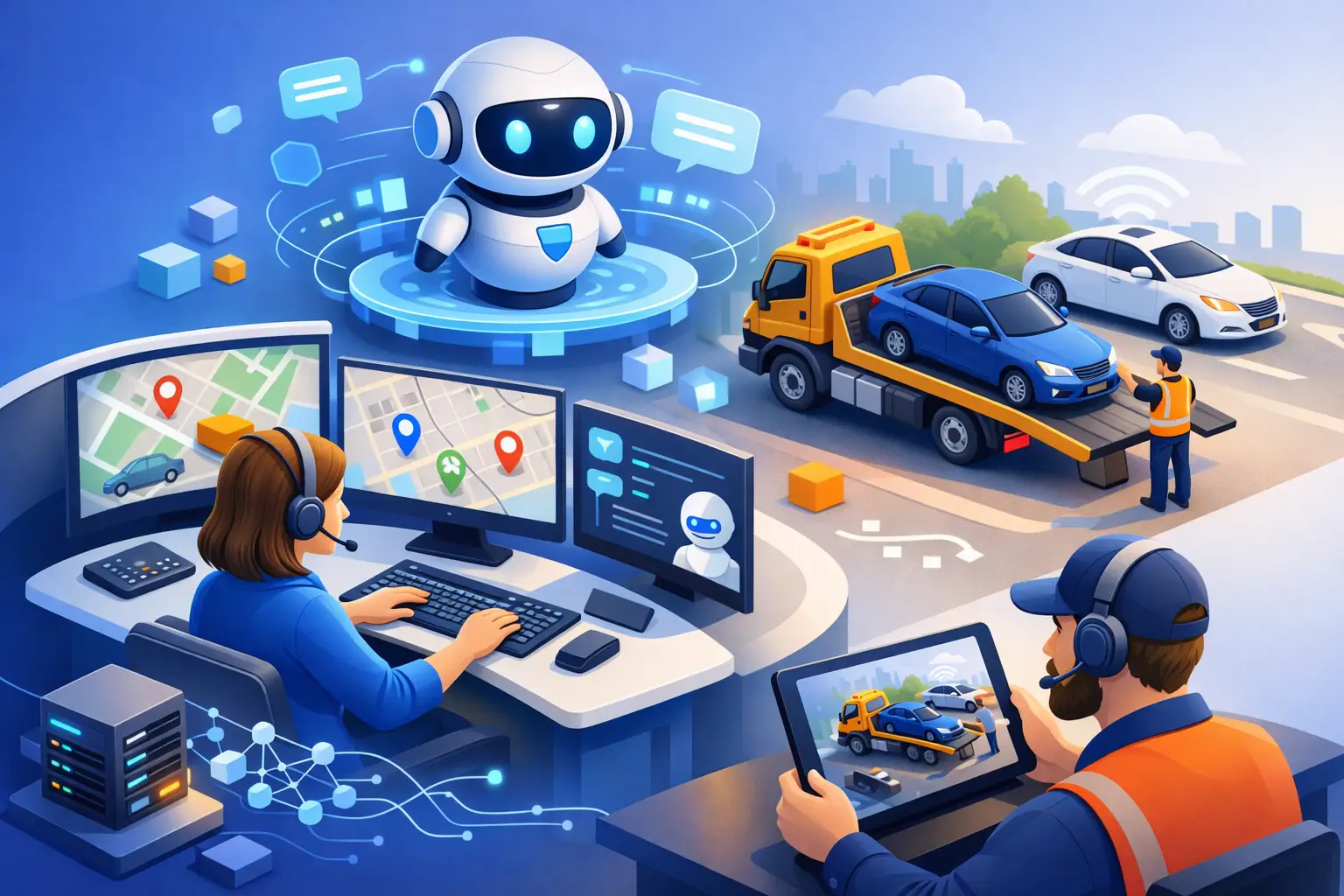
A human supported AI dispatch review should start with the call your shop cannot afford to lose: a stranded motorist at 2:14 a.m., a police impound question, or a motor club request that needs an immediate status update. The real test is not whether an AI voice can answer the phone. It is whether the system captures the right information, follows your operating rules, gets the job into dispatch correctly, and brings in a trained person when the situation requires judgment.
For towing companies, that distinction matters. Dispatch is where revenue, fleet utilization, customer experience, compliance, and driver productivity meet. A generic answering service may take a message. A generic AI tool may sound polished. Neither automatically understands service areas, equipment needs, impound release policies, motor club procedures, or the difference between a simple lockout and a recovery that needs escalation.
What Human-Supported AI Dispatch Should Actually Do
The right hybrid model divides work according to what automation and people do best. AI should handle immediate answer coverage, repeatable intake, basic customer questions, call classification, and structured data collection. Human dispatch support should handle exceptions, sensitive conversations, unclear requests, routing decisions outside normal rules, complaint recovery, and any call where a wrong assumption creates cost or risk.
That is not a weakness in the system. It is the operating model. Towing calls are not uniform transactions. A caller may not know their location, may be upset, may give the wrong vehicle information, or may need help navigating an impound process. A motor club call may require specific reference details. A police rotation request may require equipment that is already committed. The system needs defined rules for each scenario, plus a person who can take control when the script no longer fits the call.
A credible provider should be able to explain exactly what happens at each handoff. Ask whether the AI transfers the caller, alerts a dispatcher, creates a queue item, or completes a structured job record before escalation. Ask who owns the call if a live dispatcher is busy. Ambiguous handoffs are where callbacks, duplicate entries, and missed jobs start.
Human Supported AI Dispatch Review: The Operating Tests
A useful review is not a feature checklist. It is a workflow test based on your actual call volume and service mix. Pull a representative group of daytime, after-hours, roadside, impound, motor club, and complaint calls. Then evaluate how the provider would manage each one from first ring through job completion.
Call capture and caller experience
First, measure speed to answer. After-hours calls often go to the company that answers first, especially for cash calls and time-sensitive roadside requests. But fast pickup only helps if the caller can move through intake without repeating themselves or getting trapped in a rigid conversation.
The system should identify the essentials: callback number, location, vehicle type, service need, destination when applicable, safety concerns, payment or billing path, and membership or motor club details. It should also confirm critical information before the job moves forward. A bad address, wrong vehicle class, or missing reference number can turn a captured call into an expensive operational error.
Listen for how the service handles uncertainty. Can the caller ask for a person? Does the system recognize when it has not understood the response? Can it handle noisy roadside calls, poor cell coverage, and callers who describe locations by landmarks rather than street addresses? The answer does not need to be perfect every time. It does need to fail safely and escalate quickly.
Towbook workflow and job accuracy
For a Towbook operation, integration is not a technical detail. It is the difference between a phone-answering layer and a dispatch system that actually reduces work. Review how call details enter Towbook, what fields are populated, which jobs require human verification, and whether the process follows the way your team already dispatches.
A strong workflow can create or prepare jobs with consistent information, route them by your service rules, and preserve call notes for the dispatcher and driver. It should reduce duplicate entry without forcing the company to abandon the controls that protect accurate billing and job assignment.
Ask pointed questions about edge cases. What happens when the caller is an existing customer but their phone number is not recognized? How are impound inquiries documented? How does the system treat a request that falls outside your coverage area? Can it distinguish a customer asking for an ETA from a new service request? Those details determine whether automation saves dispatcher time or simply moves cleanup work to the next person.
Routing rules that match the fleet
Towing dispatch decisions depend on more than ZIP code. The right truck, driver certification, equipment availability, rotation requirements, traffic conditions, storage-yard procedures, and customer priority can all change the best response. A hybrid dispatch service should be configured around those realities rather than offering a one-size-fits-all call flow.
Review the routing rules in plain language. Define who receives calls during business hours, after hours, overflow periods, and emergency situations. Specify which call types are eligible for automated intake and which must go directly to a human. Establish rules for heavy duty, police work, specialty equipment, impounds, accident scenes, and motor club jobs.
The provider should also show how rules are changed. Your operation will change with staffing, contracts, seasonal volume, and territory. If an update requires a long support ticket cycle, dispatch control is not really yours. Towing Forward, for example, positions the hybrid model around towing-specific call flows and custom routing rather than generic receptionist coverage. That is the standard to look for, whether you are replacing overnight staff or adding coverage around an in-house team.
Human escalation and accountability
“Human-supported” can mean very different things. In one model, a human is technically available but only receives a voicemail or delayed escalation. In another, trained dispatch personnel actively monitor exceptions, take live transfers, and work inside defined operating procedures. The second model is what protects service quality when the call gets complicated.
Ask who those people are and what they know. Can they explain a basic impound process without improvising policy? Do they understand towing terminology, equipment categories, motor club expectations, and the urgency of roadside calls? Are they trained on your company’s service area, rates, after-hours policies, and escalation contacts?
Accountability should be visible. You should know how calls are categorized, why a call was escalated, whether a job was created, and who handled the exception. Call recordings, activity logs, disposition reporting, and periodic workflow reviews give owners the ability to inspect performance instead of relying on anecdotes.
Cost Should Be Measured Against Missed Revenue
The lowest per-call price is not always the lowest dispatch cost. An inexpensive service that misses cash calls, creates bad jobs, or sends drivers to incomplete locations can cost more than it saves. At the same time, a premium hybrid service is not automatically justified if your overnight volume is low and your call patterns are simple.
Compare costs against the staffing and revenue picture you actually have. Include overnight wages, overtime, turnover, training time, abandoned calls, slow callbacks, and dispatcher time spent re-entering information. Then estimate the value of additional captured calls and the operational impact of faster job creation.
It depends on your fleet. A small two-truck operation may primarily need dependable after-hours answer coverage with simple escalation. A multi-truck company handling impounds, roadside contracts, and motor club volume may need deeper Towbook workflows, detailed routing, and active human dispatch support. The right service scope follows the operational problem, not the biggest feature package.
Questions to Ask Before You Commit
Before signing, request a walkthrough using real call types from your operation. Do not accept a polished demo built around an easy tow request. Test a difficult address, an upset impound caller, a motor club assignment, an ETA request, a heavy-duty inquiry, and a call that requires immediate human intervention.
You should also get clear answers on implementation. Find out how long it takes to map call flows, configure routing, connect Towbook, train the dispatch team, and test edge cases. Ask what reports you receive, how quality assurance works, and how quickly rules can be changed after launch. Most importantly, establish the metrics you will review: answer rate, abandoned calls, job creation accuracy, escalation time, booked-call rate, and after-hours revenue capture.
A dispatch partner earns trust one call at a time. Choose the model that gives callers a fast answer, gives your drivers usable job information, and gives management proof that control did not disappear when the phone started ringing after hours.
Leave a Reply