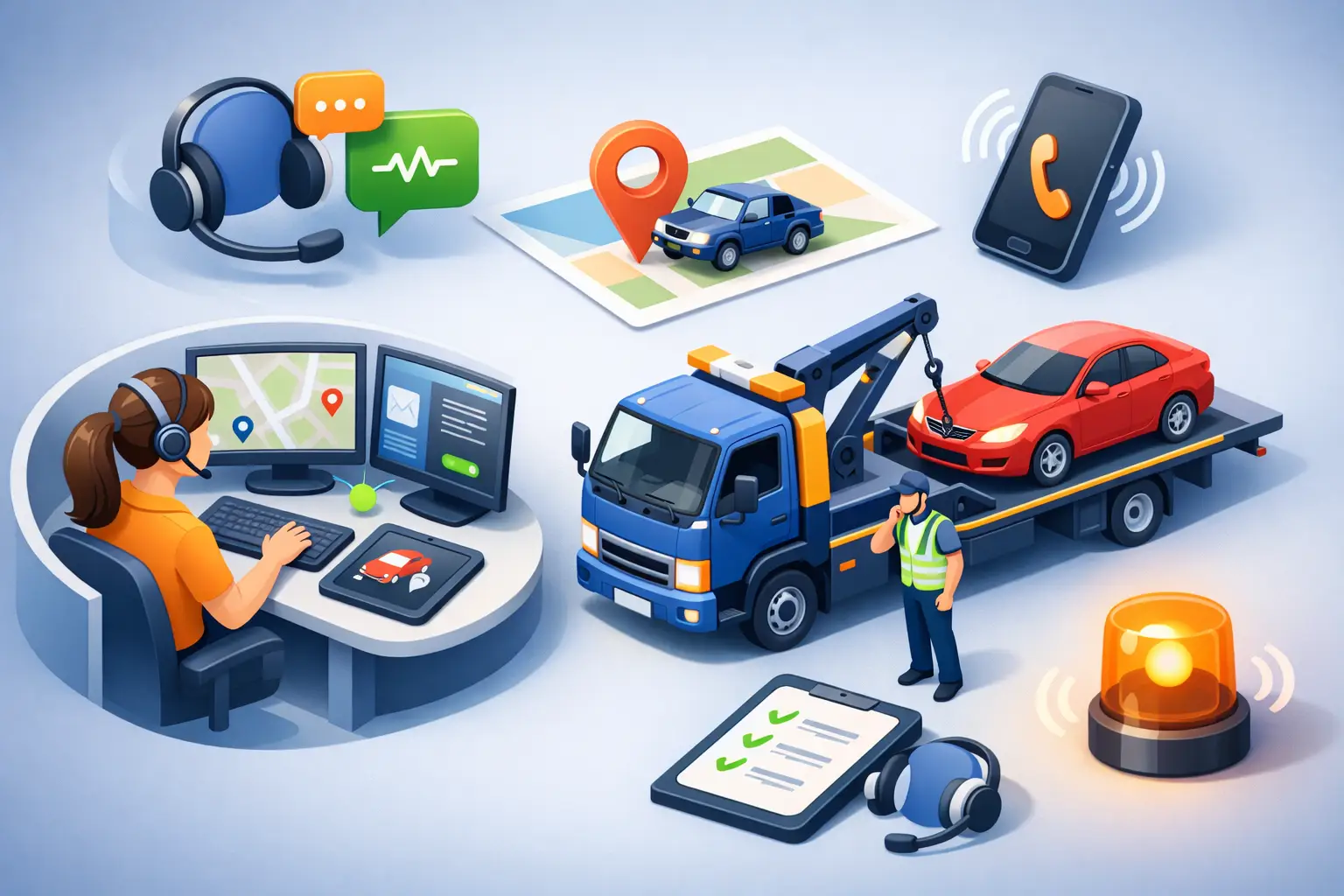
A phone call is often the first operational test your towing company faces. A stranded driver wants an ETA. A police department needs a unit assigned. An impound customer may already be frustrated before anyone answers. The best towing call handling practices turn those high-pressure conversations into complete, dispatch-ready jobs instead of missed revenue, bad data, or avoidable escalations.
For most towing operations, the goal is not simply to answer faster. It is to capture the right information, apply the right routing rule, create the job correctly, and give the caller a clear next step. That standard must hold at 2 p.m., during a weather event, and at 2 a.m. when in-house coverage is thin.
Start With a Call Flow Built for Towing
Generic call-center scripts fail because towing calls are not generic. The questions that matter change by call type, service area, vehicle condition, equipment needed, contract requirements, and whether the vehicle is blocking traffic. A caller should not have to repeat the same details after being transferred, and a dispatcher should not have to reconstruct the job from incomplete notes.
Build separate call flows for the work you actually perform. Roadside calls need an exact location, vehicle description, problem type, destination if applicable, and callback number. Tow requests also require questions about vehicle size, drivability, access constraints, and whether keys are available. Motor club calls need membership or dispatch reference details and must follow the contract workflow. Police, property-owner, and private impound calls require a different level of documentation and escalation.
The opening should be direct: identify the company, confirm whether the caller is safe, and establish the service needed. If there is an immediate traffic hazard, accident scene, or emergency condition, the call flow should prioritize that status before collecting routine details. Dispatchers need a clear rule for when to involve emergency services rather than trying to manage a dangerous situation through a standard tow intake.
A useful call flow does not mean reading a rigid script word for word. It means ensuring critical information is captured in a predictable order. The customer can speak naturally while the dispatcher follows a proven sequence behind the scenes.
Capture Details That Prevent Failed Dispatches
A job can look complete in the system and still fail in the field. The usual cause is not a lack of effort from the driver. It is a missing or inaccurate detail that should have been confirmed during intake.
Location is the most common example. “I’m by the gas station off I-75” is not enough to dispatch confidently. Require the direction of travel, nearest exit or mile marker, cross streets, visible landmarks, and a live callback number. For parking lots, apartment complexes, and large commercial properties, capture the building number, entrance, or lot section when available. A few extra seconds on the call can save 20 minutes of searching.
Equipment matching deserves the same discipline. Ask about vehicle type, condition, wheel position, damage, clearance, modifications, and cargo. Is it a sedan with a dead battery, a locked pickup in a garage, an all-wheel-drive SUV with collision damage, or a loaded box truck? The right answer determines whether you send a service truck, wheel-lift, flatbed, heavy-duty unit, or a driver with specialized equipment.
Destination details matter, too. Confirm the full address, not just the business name. Ask whether the vehicle can be dropped after hours, whether keys must be left in a specific place, and whether the customer has arranged acceptance. If a shop is closed and cannot receive the vehicle, that needs to be clear before the truck leaves.
Make Every Call Produce a Clean Dispatch Record
Call handling and data entry should be one process, not two disconnected tasks. When callers are placed on hold while someone manually retypes notes into a system, errors increase and call times stretch. When the job enters Towbook with incomplete fields, the driver inherits the cleanup work.
The best operating model creates the dispatch record as the call progresses. Customer information, pickup location, vehicle details, service type, pricing notes, special instructions, and payment status should land in the correct fields. This gives the assigned driver usable information immediately and gives management a reliable record later.
Standardized notes are especially valuable. Instead of vague entries such as “customer waiting,” use operational notes such as “Silver Honda Accord, disabled in north parking lot near rear loading dock. Customer in vehicle. Keys available. Deliver to address confirmed with service advisor.” The difference is not cosmetic. It reduces driver callbacks, improves arrival accuracy, and protects the company if there is a dispute.
Automation can accelerate this work, but only if the workflow reflects your actual operation. Custom service types, territory rules, rate structures, required fields, and escalation paths need to be configured before automation is trusted with live calls. Towing Forward, for example, centers its call workflows around towing-specific routing and Towbook integration rather than treating dispatch as a generic answering service.
Use Routing Rules Before the Call Volume Spikes
The time to decide who handles a call is not when three phones ring at once. Routing rules should be defined in advance by geography, equipment, job type, customer account, priority level, and time of day.
A light-duty roadside request in your core territory may go to the next available qualified unit. A police rotation call may require a designated dispatcher and a specific acknowledgment process. A heavy-duty inquiry may need immediate review by someone who understands capacity, permits, and recovery requirements. An impound release request may belong with office staff during business hours and an after-hours procedure outside those hours.
This is also where many companies lose control of their after-hours coverage. Forwarding every evening call to one driver might seem inexpensive, but it creates inconsistent intake, interrupted sleep, missed calls when the driver is on a job, and little visibility into what was said. A defined after-hours call flow gives callers an answer, captures the job, and escalates only the exceptions that truly need human intervention.
The right routing model depends on fleet size and workload. A three-truck company may need simple rules that protect the owner from nonstop phone interruptions. A multi-location operation may require rules by zone, partner yard, account, and equipment class. Complexity is not the goal. Consistency is.
Treat ETAs and Pricing as Operational Commitments
Customers remember two things after a towing call: whether someone answered and whether the company did what it said. Avoid promising an ETA before checking unit availability, location, and job complexity. An optimistic answer may feel helpful in the moment, but a missed promise creates complaints and ties up the phone with status calls.
Give a realistic arrival range based on live fleet conditions. If traffic, weather, a prior recovery, or distance could affect timing, say so plainly. Then document the ETA communicated to the caller. This helps the dispatcher, driver, and customer operate from the same expectation.
Pricing deserves similar discipline. Call handlers should understand approved rate ranges, account terms, payment requirements, storage policies, and when a quote needs review. They should not improvise a price to get a caller off the phone. If the job has variables such as winching, multiple vehicles, inaccessible location, or a long loaded mile, explain that final charges may depend on confirmed conditions.
Clear communication protects margins without sounding defensive. Customers can handle a straightforward explanation. What they do not tolerate is a surprise charge that no one mentioned or a quote that changes because the original call was poorly documented.
Build a Serious Process for Impounds and Complaints
Impound inquiries are rarely routine for the person making the call. The caller may be upset, confused about fees, or accusing the company of wrongdoing. Your team needs a calm, repeatable process that verifies identity, confirms vehicle and lot status, explains release requirements, and documents the interaction.
Do not let call handlers guess about release rules, payment methods, required identification, lienholder authorization, or hold status. Give them current, approved language and a path to escalate exceptions. The same applies to complaints. The initial objective is to listen, capture facts, avoid arguing, and route the issue to the right person with a complete record.
A complaint that is handled professionally can preserve an account or prevent a public review from becoming a larger operational problem. A complaint that is dismissed, transferred repeatedly, or documented poorly becomes much harder to resolve.
Measure the Calls You Are Paying For
If you cannot see what happens after the phone rings, you cannot improve it. Review call handling through operational metrics, not just total call volume. Answer rate, abandoned calls, missed after-hours calls, average speed to answer, booking rate, dispatch time, data completeness, driver callback frequency, and complaint volume each reveal a different weakness.
Listen to a sample of calls regularly. Look for patterns: Are dispatchers failing to confirm destinations? Are callers asking for ETAs multiple times? Are motor club details missing? Are certain calls being transferred without a reason? Quality review should lead to changes in scripts, system fields, training, or routing rules, not vague reminders to “do better.”
The strongest towing call handling operation is one your drivers can trust. When the phone team captures the facts, creates clean jobs, communicates honestly, and follows the same rules every time, your fleet spends less time correcting dispatch mistakes and more time completing profitable work.
Leave a Reply