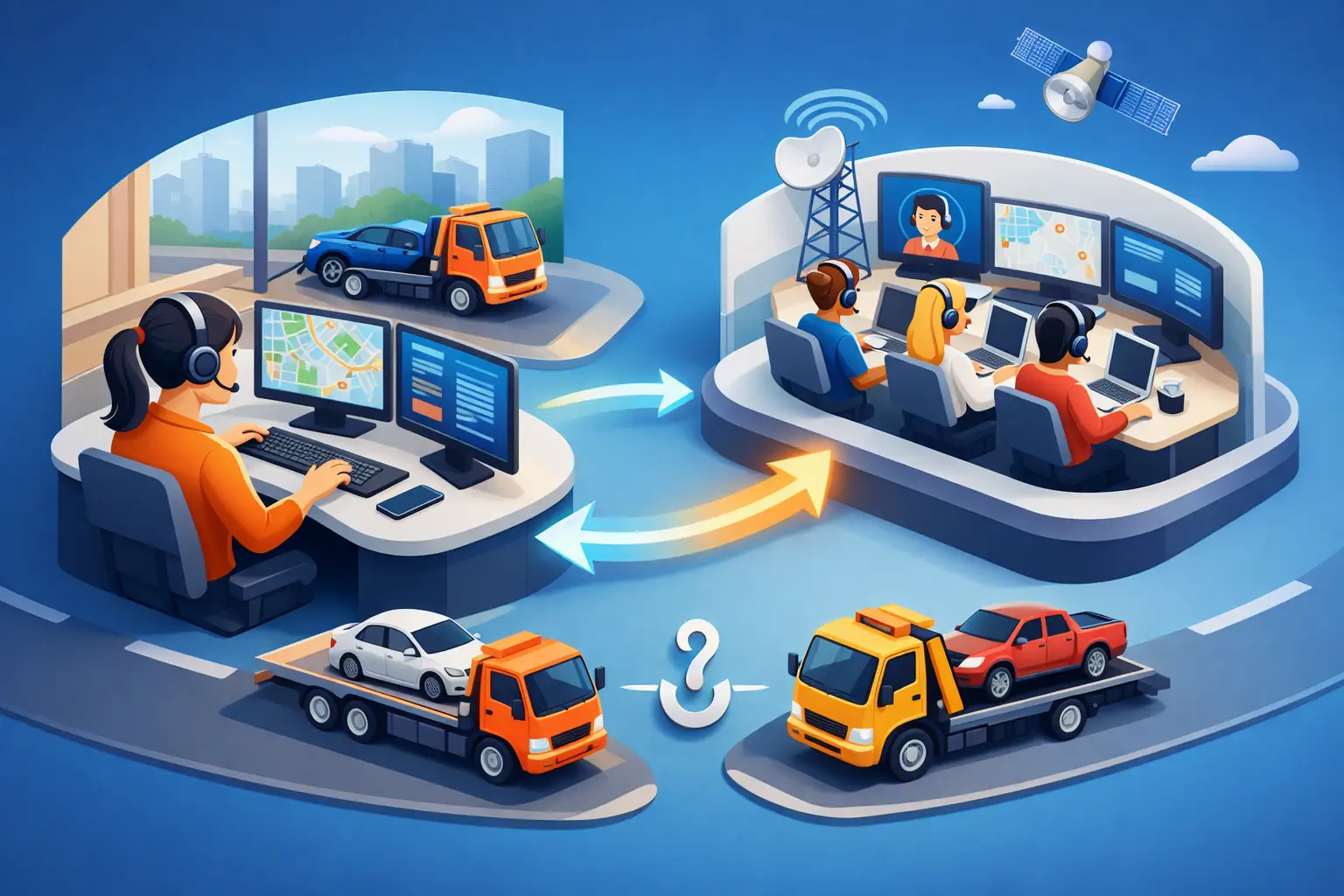
A truck can be available, a driver can be ready, and a customer can still call the next towing company if nobody answers within a few rings. That is the real question behind when should tow companies outsource dispatch. It is not simply a staffing decision. It is a decision about call capture, job quality, driver utilization, customer experience, and whether your operation can respond consistently when demand spikes.
For many towing companies, dispatch becomes the bottleneck long before it looks like one on a payroll report. The owner is covering calls between other responsibilities. A day dispatcher is carrying too much information in their head. After-hours calls go to voicemail, ring unattended, or are answered without proper job intake. The business may have good trucks, reliable drivers, and steady demand, but the front door of the operation is not controlled.
When Should Tow Companies Outsource Dispatch?
Tow companies should consider outsourced dispatch when inbound call volume, coverage requirements, or dispatch complexity exceed what the current team can handle reliably. The trigger is usually not one bad shift. It is a repeated operational pattern: missed calls, delayed dispatches, inconsistent Towbook entries, frustrated drivers, or an owner who cannot step away from the phone.
A practical test is to look at where calls fail. If calls are missed during lunch, driver changeovers, nights, weekends, storms, or motor club surges, you have a coverage problem. If calls are answered but job details are incomplete, vehicle information is wrong, payment expectations are unclear, or the wrong truck gets assigned, you have a process problem. If your dispatchers are competent but overloaded, you have a capacity problem.
Each problem has a cost. A missed private-pay tow is lost revenue. A poorly documented impound inquiry creates unnecessary callbacks and potential customer friction. A delayed motor club assignment can affect performance scores. A driver sent without complete information loses productive time and burns fuel. Outsourcing makes sense when the combined cost of these failures is higher than the cost of adding disciplined, always-on dispatch coverage.
The common warning signs
One warning sign is heavy owner involvement. Owners should be able to review exceptions, manage key accounts, and make operational decisions. They should not be required to answer every after-hours roadside call because there is no reliable intake process.
Another is constant dispatcher turnover. Towing dispatch is demanding work. A new hire needs to understand service areas, equipment, impound procedures, motor club requirements, driver availability, payment policies, and the pressure of a caller stranded on the roadside. When turnover repeatedly resets that knowledge, the operation loses consistency.
The third is unreliable after-hours coverage. Some companies pay overtime for an in-house dispatcher. Others rotate the phone among drivers or managers. Both can work for a limited period, but they become expensive or fragile as call volume grows. A tired driver cannot safely manage a roadside job and conduct a detailed intake call at the same time. A manager who is always on call eventually becomes a constraint on growth.
Compare the Real Cost, Not Just the Hourly Rate
Outsourcing is not automatically the right move because an external provider appears cheaper per hour. The better comparison is the fully loaded cost of owning dispatch performance internally.
An in-house overnight dispatcher involves more than wages. There are payroll taxes, benefits where applicable, overtime, training time, management time, turnover, scheduling gaps, and the cost of calls that are mishandled while a new employee learns the operation. There is also the cost of maintaining coverage for sick days, vacations, peak nights, and unexpected volume.
Then measure the revenue side. Review how many calls reach voicemail or go unanswered. Estimate how many of those could have become billable jobs. Track abandoned calls, callbacks, canceled jobs caused by slow response, and jobs that required rework because the initial intake was incomplete. A dispatch decision should be based on captured revenue and protected margin, not just reduced payroll.
A company with low, predictable daytime volume may still be better served by an internal dispatcher. A company with uneven volume, multiple service lines, active after-hours demand, or frequent peak periods often benefits more from a hybrid model. The goal is not to remove people for the sake of automation. It is to place the right level of coverage at every point in the call flow.
Outsource Coverage and Repetition, Not Operational Judgment
The strongest outsourced-dispatch arrangements do not hand over the entire business without rules. They outsource repeatable work while keeping the company in control of decisions that require local knowledge, management authority, or a direct customer relationship.
After-hours call answering is often the logical first step. An outsourced team can capture roadside requests, collect vehicle and location details, classify the call, follow your routing rules, create the job in Towbook, and escalate exceptions. This protects revenue during the hours when internal coverage is least efficient.
Overflow handling is another strong use case. During storms, police rotation bursts, motor club surges, and high-volume weekends, your internal team may need help without surrendering normal daytime control. Overflow coverage prevents hold times from climbing and gives dispatchers room to focus on active jobs instead of racing through ringing phones.
Companies can also outsource standardized work such as impound inquiry intake, status calls, basic ETA communication, and repetitive administrative call handling. These calls matter, but they should follow consistent scripts, documented policies, and clear escalation rules.
What should remain controlled internally depends on the operation. A manager may want to retain authority over high-value commercial accounts, sensitive complaint resolution, police-agency relationships, unusual recoveries, rate exceptions, and disciplinary issues. A capable outsourced dispatch partner supports that structure by escalating the right calls, not by making decisions it was never authorized to make.
Control Depends on Workflow Design
Outsourcing fails when a provider answers calls without understanding your equipment, service area, job priorities, or rules. It also fails when calls are handled in a separate system and must be manually re-entered later. That creates delays, duplicate work, and gaps in accountability.
Before moving any calls, document the dispatch workflow. Define service areas, truck types, pricing boundaries, payment requirements, motor club procedures, impound release rules, preferred drivers, prohibited jobs, and escalation contacts. Specify what should happen when a caller needs a flatbed, when police are on scene, when a vehicle is in a dangerous location, or when no driver is immediately available.
Towbook integration is particularly important for companies already using the platform. The job record should move into the same operating system your drivers and managers use. That gives the team visibility into caller details, notes, status changes, assigned units, and job history. It also avoids the familiar problem of dispatch information living in a text message, a notebook, and an employee’s memory instead of in the actual workflow.
The right provider should work from custom routing rules rather than generic call-center scripts. A towing call is not a generic customer-service interaction. A dispatcher must collect accurate location information, identify the vehicle and condition, understand the requested service, recognize urgency, and route the job according to real fleet availability and company policy.
Start With a Measurable Pilot
You do not need to outsource every call on day one. Start with a defined coverage window, such as nights and weekends, or with overflow during business hours. Set the standards before the pilot begins: call-answer rate, abandoned-call rate, time to create a job, data-entry accuracy, escalation compliance, jobs captured, and customer complaints.
Review calls and outcomes weekly during the first month. Look beyond whether a call was answered. Was the correct service identified? Did the driver receive enough information? Was the job routed correctly? Were exceptions escalated promptly? Did your team retain full visibility in Towbook?
This review period is where operational improvements happen. Routing rules become sharper. Escalation paths become cleaner. Repeated caller questions may reveal that your pricing, service-area, or impound information needs better documentation. Outsourced dispatch should create more discipline inside the business, not hide existing process issues.
Towing Forward is built for this type of controlled transition, combining towing-specific call handling, AI-powered voice coverage, human support, and Towbook-centered workflows so companies can expand coverage without giving up operational visibility.
The best time to outsource is before missed calls and exhausted staff become normal. If dispatch is limiting response time, revenue capture, or your ability to scale, build a coverage model that answers every call with the same urgency your drivers bring to the road.
Leave a Reply