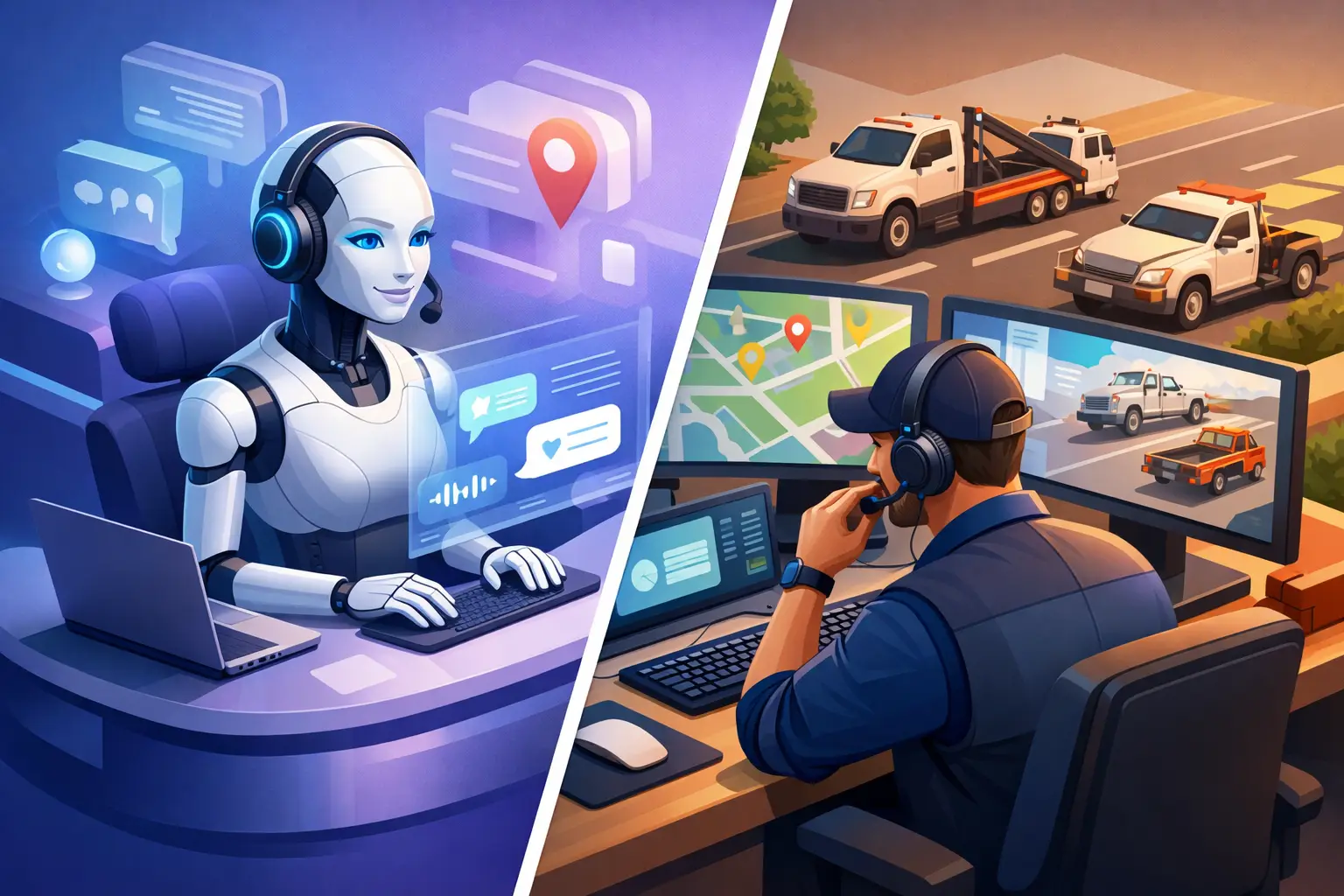
A ringing phone is not just a customer-service event in a towing company. It can be a motor club assignment with a tight acceptance window, a cash call ready to go elsewhere, an impound inquiry tying up the line, or a stranded driver who needs accurate expectations now. The AI receptionist versus dispatcher decision comes down to one operational question: does your business need someone to answer calls, or does it need the call moved all the way to a controlled, dispatchable job?
Those are not the same service. Confusing them is how towing operators end up paying for call coverage while still dealing with incomplete notes, missed requirements, delayed truck assignments, and dispatchers who must clean up every intake later.
AI receptionist versus dispatcher: the real distinction
An AI receptionist is primarily an inbound-call layer. Its job is to greet the caller, identify the reason for the call, gather basic information, answer approved questions, and route the interaction to a person or inbox. For a towing business, it may collect a name, callback number, vehicle location, vehicle description, and a general request such as lockout, tow, roadside assistance, or impound information.
That can be useful. If the alternative is an unanswered after-hours phone, voicemail, or a dispatcher trying to manage radio traffic while taking every incoming call, a receptionist layer captures more opportunities. It creates a consistent first response and can reduce the interruption load on the team.
A dispatcher owns the next operational step. Dispatch requires deciding what information is needed for the job type, determining whether the call meets service rules, selecting the right truck or escalation path, documenting the work correctly, communicating expectations, and monitoring the job until responsibility is handed off or the issue is resolved.
In towing, the gap is significant. A caller who says, “My car won’t start at the grocery store,” has not provided a dispatch-ready ticket. Is it a jump start, tow, or diagnostic roadside request? Is the vehicle in a parking garage with clearance restrictions? Is it an electric vehicle? Does the caller have motor club coverage? What is the exact entrance, destination, payment method, and promised ETA? The dispatcher has to turn a conversation into an executable job.
What an AI receptionist can do well
An AI receptionist is a strong fit when the call is simple, repetitive, and governed by clear rules. It can answer every call immediately, provide standard business hours, collect callback details, handle straightforward status requests, and identify the broad reason for the call before routing it.
It can also protect the front end of your operation during high-volume periods. A one-truck company may be on a recovery, unable to safely answer the phone, while a multi-truck fleet may have dispatchers focused on active calls, police rotation work, or motor club assignments. In both cases, instant call answering prevents the customer from hearing silence or reaching a generic voicemail box.
For impound-related calls, an AI receptionist can provide approved general guidance and identify the caller’s need. But it should not guess about a vehicle’s status, release requirements, fees, or lot access. Those answers must follow your company’s policies and local requirements. A good system knows when to provide a standard response and when to hand the call to a trained person.
The same principle applies to complaints. Automation can recognize the issue, gather the basics, document the caller’s concern, and route it using a priority rule. It should not argue, make promises outside policy, or leave a frustrated customer trapped in a loop.
Where receptionist coverage stops short
The limitation is not that an AI receptionist is ineffective. The limitation is scope.
If the system only collects a message and sends an alert, your team still has to call back, confirm the details, build the ticket, determine availability, assign the truck, and update the customer. That may be acceptable for low call volume or informational calls. It is a weaker answer when speed to dispatch determines whether you win the job.
A receptionist-first workflow can also create duplicate work. The caller explains the situation once to the AI, then again to a dispatcher. The dispatcher re-enters information into Towbook. Details may be missing, abbreviated, or captured in a format that does not match how your operation needs to price, route, and document work.
That friction is particularly expensive overnight. Staffing a capable overnight dispatcher is difficult and costly, but a basic answering service often shifts the workload to the morning team or to an on-call owner. The phone was answered, yet the operation was not fully covered.
What a dispatcher is responsible for
Dispatch is a decision-making function, not just a phone function. A capable towing dispatcher manages intake, prioritization, truck fit, service-area rules, communications, documentation, and exceptions. The role is accountable for moving work through the system without creating avoidable delays or bad information downstream.
For a roadside assistance call, that means confirming the service type, exact location, vehicle, access conditions, payment or club details, and customer expectations. For a motor club call, it means following acceptance and status requirements. For an impound inquiry, it means following the correct release and escalation path. For a police or rotation assignment, it means applying the right urgency and equipment rules.
The best dispatch process also keeps the system of record current. If your team uses Towbook, jobs should be entered with the fields, notes, statuses, and routing logic your fleet needs. A job that lives only in a text message, email, or handwritten note is harder to assign, track, invoice, and audit.
Human judgment remains essential in edge cases. A truck may be technically available but poorly positioned. A caller may be unsafe. A customer may need a specialty unit. Weather, traffic, lot restrictions, driver skill, and local relationships can change the correct answer quickly. These are not reasons to avoid automation. They are reasons to use automation with clear escalation paths and operational oversight.
The better model for most towing companies
For many operators, the choice is not an AI receptionist or a dispatcher. It is an AI-powered dispatch model that uses each resource where it performs best.
AI should handle the immediate response, routine intake, repetitive questions, call classification, approved scripts, and structured data capture. It should follow your routing rules, recognize when a request is urgent or unusual, and create a clean handoff rather than a vague message. When the call meets defined criteria, the workflow can move directly into your dispatch process instead of waiting for manual re-entry.
Trained towing dispatchers should handle the judgment-heavy work: complicated service requests, upset customers, motor club exceptions, impound escalations, ambiguous locations, pricing issues, driver coordination, and any call that requires policy interpretation. This gives customers a fast first response without pretending that every towing scenario can be handled by a generic bot.
Towing Forward applies this hybrid structure to towing operations with custom call flows, Towbook-integrated workflows, and human support for the situations that require it. The point is not to automate for appearances. The point is to reduce missed calls and dispatch friction while preserving control over how every job is handled.
How to choose the right level of coverage
Start by reviewing what happens after the phone is answered. Pull a sample of after-hours calls, abandoned calls, missed calls, and jobs that required multiple callbacks. Look for the point where the workflow breaks down.
If your main issue is that callers cannot reach anyone, an AI receptionist may provide immediate value. If your main issue is that jobs are captured but not dispatched quickly or accurately, you need a deeper dispatch workflow. If your in-house team handles daytime demand well but nights, weekends, and surge periods are inconsistent, hybrid coverage is often the practical answer.
Also measure more than call volume. Track answer rate, abandoned-call rate, time from first ring to job creation, time from job creation to truck assignment, repeat-call rate, and the number of tickets that need correction. These metrics reveal whether your coverage model is actually improving fleet responsiveness or simply adding another layer between the caller and the truck.
A useful operating rule is simple: do not buy a phone-answering solution when the real problem is job execution. Build coverage around the outcomes your company needs – more captured revenue, faster dispatch, cleaner Towbook records, fewer overnight staffing gaps, and a customer who knows what happens next.
The next call may be routine, urgent, profitable, or complicated. Your process should be ready to identify which one it is and move it forward without making the customer, driver, or owner carry the burden of a broken handoff.
Leave a Reply