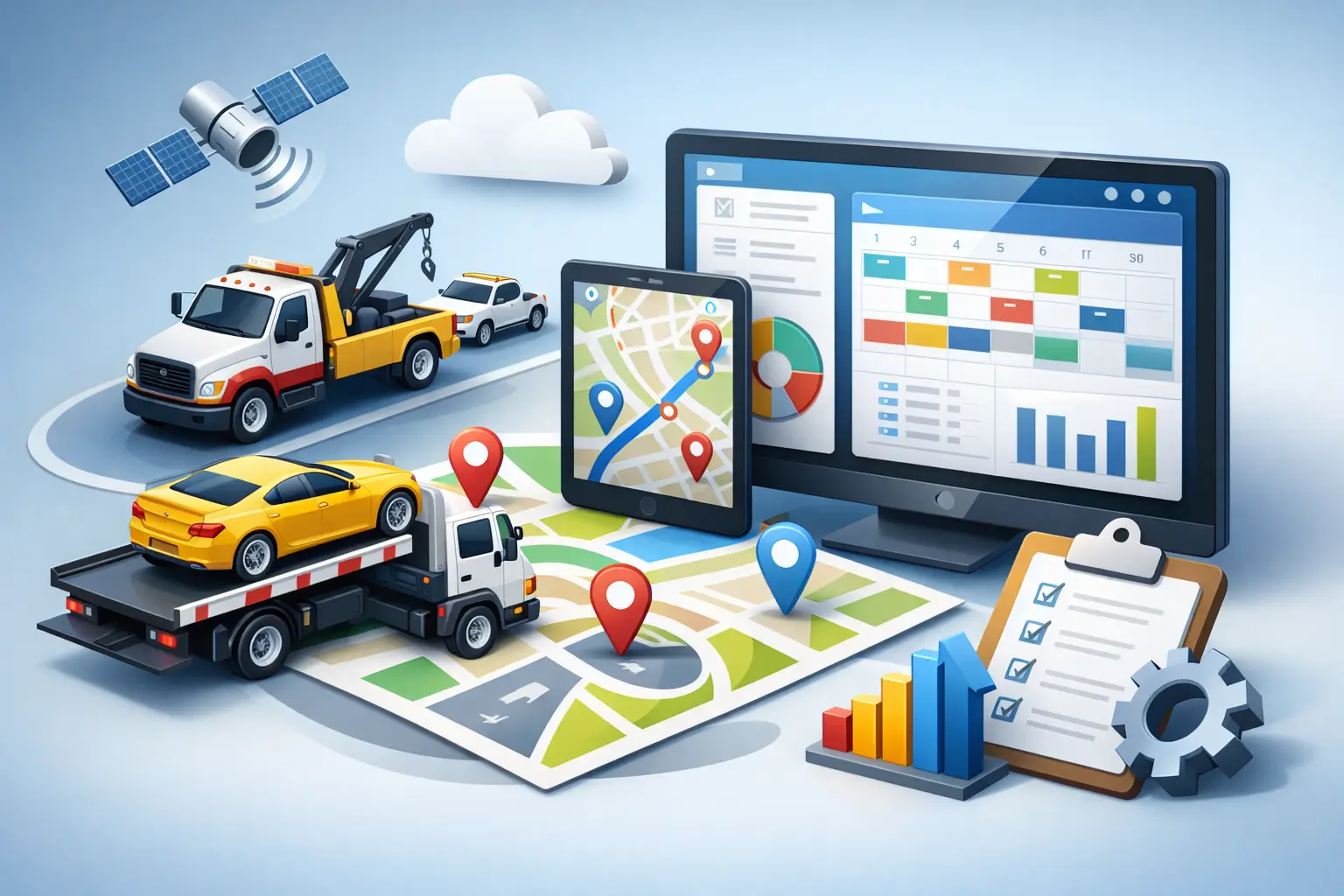
A dispatcher can have the best screen in the office and still lose revenue if the phone rings unanswered at 2:00 a.m. That is the central issue behind any tow truck dispatch software comparison: the right choice is not simply the platform with the longest feature list. It is the setup that captures calls, creates accurate jobs, moves the right truck quickly, and gives the owner confidence that the operation is under control.
For towing companies, dispatch software sits at the center of roadside calls, impound releases, motor club assignments, private-property work, customer updates, driver status, and billing. A weak fit creates duplicate entry, poor handoffs, missed ETA updates, and dispatchers who spend more time fighting the system than moving trucks. A strong fit makes the workflow faster without forcing the company to sacrifice visibility or control.
What a Tow Truck Dispatch Software Comparison Should Measure
Many software comparisons start with features: GPS, mobile apps, invoicing, text notifications, reporting, and integrations. Those matter, but they do not tell the full operational story. Towing owners should compare solutions based on what happens from the first ring through job completion.
The first question is call capture. Can the system or service reliably answer every call, collect the right information, identify whether the caller needs roadside help, an impound release, a motor club update, or a complaint, and route the call appropriately? Software that only improves the workflow after a dispatcher answers the phone leaves a major gap for shops that struggle with after-hours coverage or high call volume.
The second question is job accuracy. Towing calls are not generic service tickets. Dispatch needs vehicle location, vehicle details, destination, payment or motor club information, special equipment requirements, customer contact information, and often lot or impound details. Every time a dispatcher retypes information from a phone note into the dispatch platform, the risk of error and delay increases.
The third question is execution. A useful system should help dispatchers see available trucks, assign the right unit, communicate updates, and document the job as it progresses. But automation should not replace operational judgment. The nearest truck is not always the right truck. A loaded flatbed, a driver nearing end of shift, a specialized recovery unit, or a truck positioned for a motor club commitment may change the decision.
The Four Options Most Towing Companies Compare
Most towing operations are choosing among four models, even if vendors describe them differently: towing-specific dispatch platforms, general field-service software, standalone answering services, and managed dispatch with automation.
Towing-specific dispatch platforms
A towing-specific platform is usually the strongest starting point for companies that need dispatch, driver workflow, job records, billing, impound management, and reporting in one operational system. For fleets already using Towbook, the value is not theoretical. The platform contains the live operational record, so dispatch activity should flow directly into it rather than live in a separate call log or inbox.
The advantage is industry fit. The trade-off is that software alone does not answer phones, train new dispatchers, enforce call scripts, or cover overnight shifts. It gives your team a better operating environment, but your company still owns staffing, performance management, and call-handling discipline.
This option fits companies with dependable in-house dispatch coverage and a clear need to standardize how jobs are entered, assigned, and closed. It is less effective when the primary pain point is unanswered calls or inconsistent dispatcher availability.
General field-service software
General field-service platforms can support scheduling, GPS tracking, customer notifications, estimates, invoices, and technician workflows. They may look attractive to a growing business because they often present clean dashboards and broad integrations.
The problem is that towing has exceptions that generic workflows do not naturally handle. An impound claimant asking about documents and release requirements is not the same as a homeowner scheduling a service appointment. A police rotation request, a motor club status check, and a recovery requiring specialized equipment each require different call handling and routing logic.
A general platform may work for a company focused on scheduled transport or a business with simple job types. For an operation handling roadside volume, impounds, municipal work, or motor clubs, the cost of workarounds can exceed the savings from a lower software subscription.
Standalone answering services
An answering service can prevent calls from going to voicemail. That is valuable, especially after hours. However, not every answered call becomes a useful dispatch record.
The key difference is whether the agent can handle towing-specific conversations and place complete, actionable job details into the dispatch workflow. If an agent simply takes a message and emails it to the on-call driver, the fleet still has delays, incomplete information, and limited visibility. The owner may know a call was answered but not whether it became a booked job, how fast it was dispatched, or why it was lost.
Standalone answering is often a reasonable bridge for companies that only need overflow coverage. It becomes less compelling when call volume, after-hours demand, or dispatcher turnover makes message-taking too expensive.
Managed dispatch with automation
Managed dispatch combines trained human call handling with automation that captures information, follows routing rules, and updates the company’s operating system. This is a different purchase than software alone. The goal is not just to give your dispatcher a better tool. It is to reduce the amount of dispatcher labor your operation must carry while maintaining control over how calls and jobs are handled.
For a Towbook-based operation, the practical test is direct workflow integration. Can calls become jobs in Towbook? Can custom rules determine which calls transfer to a manager, which jobs go to an on-call driver, and which requests require a specific script? Can the owner review call outcomes and job activity without reconciling multiple systems?
Towing Forward uses this hybrid model because towing companies need both speed and judgment. AI can answer routine calls immediately, gather structured information, and apply established routing rules. Towing-trained human support remains critical for exceptions, sensitive complaints, complex impound questions, and situations where the caller needs more than a scripted response.
The trade-off is that managed dispatch requires thoughtful onboarding. Your provider needs accurate service areas, rates or payment policies, equipment capabilities, impound procedures, escalation contacts, motor club requirements, and routing rules. A company that refuses to define its process will not get the full benefit of automation. But once those rules are documented, the operation becomes more consistent and far less dependent on who happens to be answering the phone.
Compare Workflow, Not Just Features
When evaluating dispatch options, ask vendors to walk through real calls from your business. Do not accept a generic product demonstration built around an ideal service appointment. Use actual scenarios: a stranded customer who does not know their exact location, a police department requesting a rotation response, an impound claimant calling after hours, a motor club job that needs immediate acceptance, or a customer disputing a charge.
Pay attention to how many handoffs occur. A caller who speaks with an agent, waits for a callback, repeats details to a dispatcher, and then receives an uncertain ETA has experienced a broken workflow even if every individual system performed as designed. Faster dispatch comes from reducing those steps.
Also examine driver communication. A dispatch system should give drivers job details in a usable format and make status updates easy to capture. If drivers must call repeatedly for addresses, vehicle descriptions, gate codes, or payment notes, dispatch capacity disappears quickly. Mobile workflow matters, but it must match how your drivers actually work on the road.
The Cost Question Is Bigger Than the Monthly Fee
A low monthly software price can hide expensive operational gaps. Calculate the cost of overnight staffing, overtime, dispatcher turnover, missed calls, abandoned calls, delayed motor club responses, and jobs that never make it into the system. Then compare that number with the cost of improving the workflow.
A company running one or two trucks may not need a fully managed model every hour of the day. A larger multi-location operation may need it because one missed after-hours call or poor motor club response can affect far more than a single job. The right answer depends on call volume, staffing stability, job mix, and how much revenue is exposed when nobody answers.
Visibility should also be part of the cost calculation. Owners need to know how many calls were answered, how many became jobs, where calls were routed, how quickly jobs were dispatched, and what happened to calls that did not convert. Without that information, it is difficult to improve performance or hold a provider accountable.
Questions to Ask Before You Commit
Ask whether the solution is built around towing workflows or adapted from another industry. Ask how calls are handled after hours, how complete job data enters your dispatch system, and what happens when a caller has an exception that automation cannot resolve. Confirm how custom routing rules are set, who can change them, and how quickly changes take effect.
You should also ask what reporting is available. A useful operation should be able to identify missed-call risk, call volume by hour, dispatch speed, call outcomes, and recurring issues that consume dispatcher time. If the vendor cannot show how those numbers are measured, claims about efficiency are difficult to verify.
Finally, test the onboarding process. Good dispatch performance depends on accurate operating rules. The provider should have a disciplined way to document service areas, truck capabilities, escalation contacts, impound procedures, business hours, pricing guidance, and motor club requirements. That work is not administrative overhead. It is what turns a tool or service into a dependable extension of your operation.
The best dispatch decision is the one that makes your next busy night less dependent on luck. Choose the model that gives your fleet faster response, cleaner job data, measurable call accountability, and a clear path for handling the calls that do not fit a standard script.


Leave a Reply