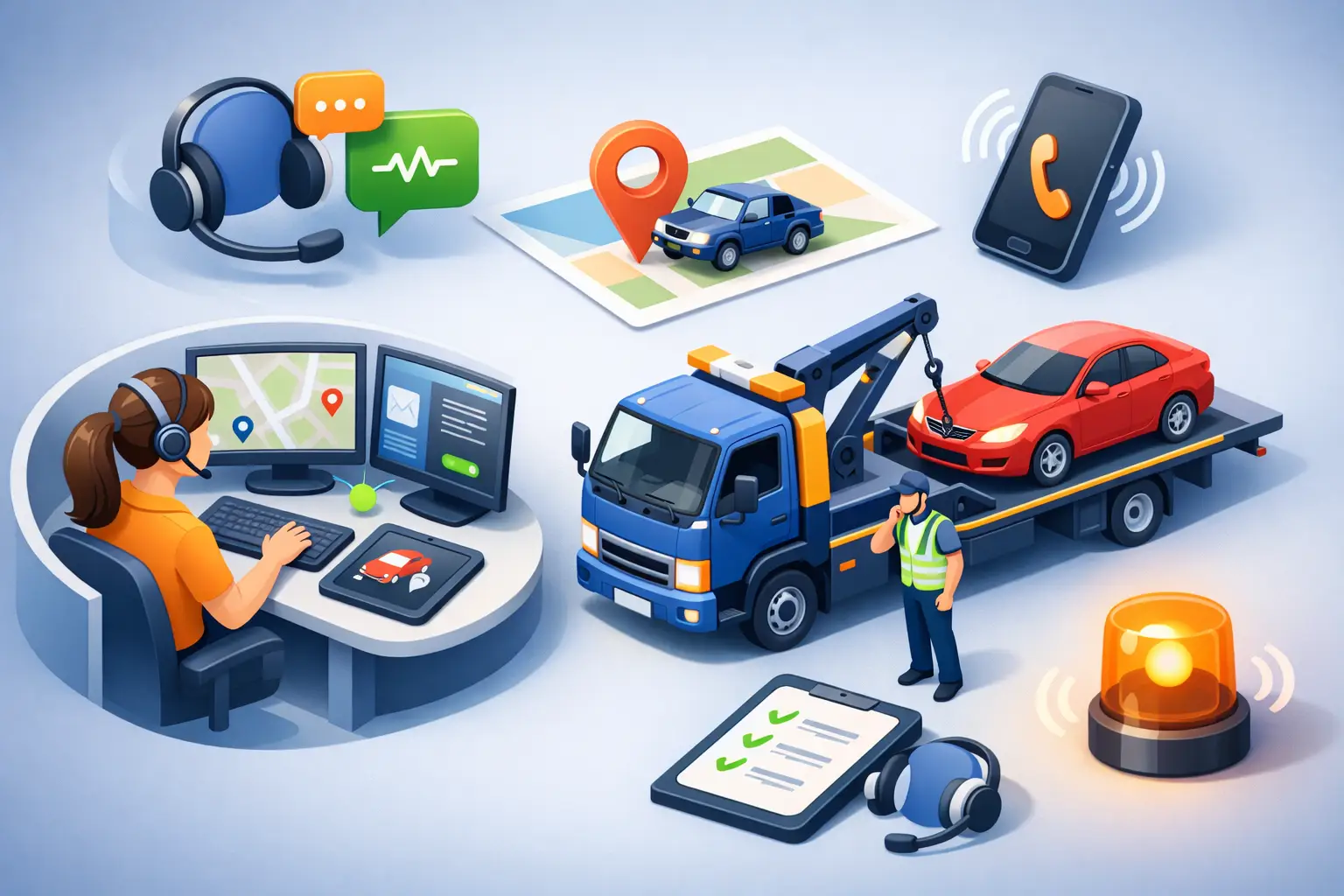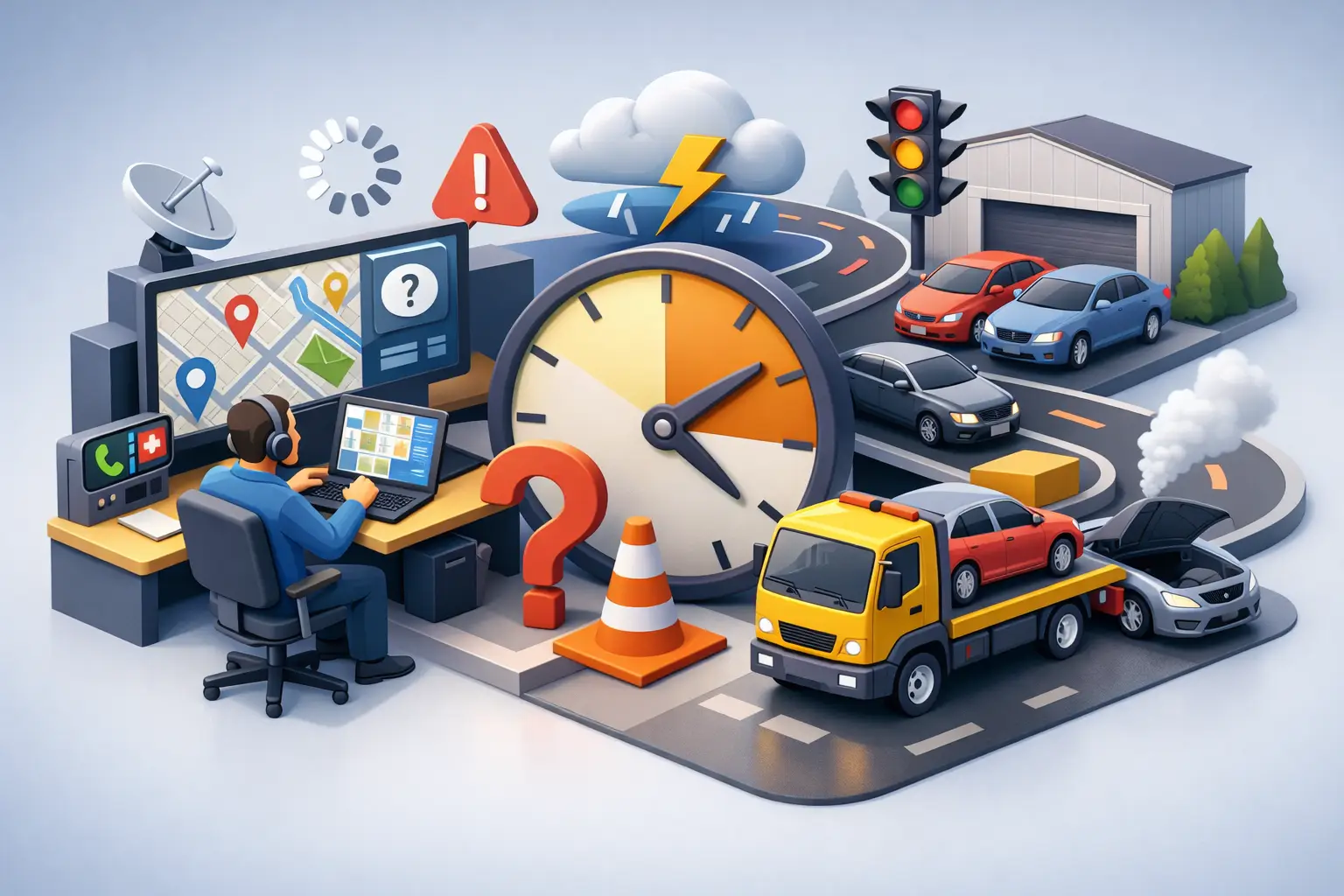
A call can be answered in 10 seconds and still cost your company money. If the dispatcher selects the wrong service type, misses a motor club requirement, gives an unrealistic ETA, or fails to enter the job correctly, the damage shows up later as a lost billable, a complaint, a chargeback, or a truck running in the wrong direction. Towing dispatch quality assurance is the process that catches those failures before they become normal operating behavior.
For towing operators, quality assurance is not a customer-service exercise borrowed from a generic call center. It is a dispatch control system. It measures whether calls are captured, whether jobs are built correctly, whether the right truck is sent, whether customers receive accurate information, and whether the records support billing and accountability.
Why Towing Dispatch Quality Assurance Matters
Dispatch sits between demand and fleet capacity. A dispatcher has to collect usable information quickly, make judgment calls under pressure, follow motor club or police procedures, and keep drivers moving. When quality varies by shift or by person, the business loses control of the operation.
The most expensive dispatch errors are often quiet. A caller may hang up after being placed on hold too long. An impound customer may receive incomplete release instructions and arrive frustrated. A roadside call may be entered without the right location details, forcing the driver to call back from the shoulder. A job may be closed with missing notes, leaving billing staff to reconstruct what happened.
None of those issues is fixed by telling dispatchers to “be more careful.” Quality improves when the company defines the correct workflow, reviews execution against that workflow, and acts on the patterns found. That is how management turns dispatch from a black box into a measurable function.
What a Dispatch QA Program Should Measure
A useful QA program does not grade every call on vague friendliness. Professionalism matters, but the scorecard should prioritize actions that protect revenue, response times, customer experience, and driver utilization.
A towing-specific review should examine whether the dispatcher:
- captured the caller’s name, callback number, location, vehicle details, and service need accurately
- selected the correct job type, priority, payment information, motor club fields, or impound workflow
- followed the correct routing rule and dispatched the proper available resource
- communicated a realistic ETA, next step, pricing boundary, or release requirement without making unsupported promises
- documented notes, changes, cancellations, and customer commitments clearly enough for the next person to act
Not every error should carry the same weight. Missing a minor note format requirement is different from dispatching a light-duty truck to a heavy-duty recovery, releasing incorrect information on an impounded vehicle, or failing to identify a scene-safety concern. Your QA form should separate coaching items from critical errors.
Critical errors deserve immediate review, not a score at the end of the month. If a mistake creates a safety exposure, compliance problem, major customer complaint, lost motor club revenue, or preventable truck movement, the supervisor should identify the root cause quickly. The cause may be training, an unclear routing rule, outdated account instructions, a software configuration issue, or a simple lapse. The corrective action should fit the actual cause.
Score the Call and the Job Record
Phone quality alone is incomplete. A dispatcher can sound confident while entering weak data. The opposite can also happen: a dispatcher may be brief and direct but create an accurate, well-routed job that gets handled correctly.
Review the recording or call transcript alongside the dispatch record. Compare what the caller requested with what entered the system. Then compare the job record with the unit sent, timestamps, driver notes, and final disposition. This creates a full chain of accountability from first ring to completed job.
For companies using Towbook, the QA process should inspect the fields and workflows that drive the actual operation: service selections, vehicle details, account requirements, dispatch status changes, notes, invoice readiness, and exception handling. A review that never reaches the system of record will miss the errors that affect fleet performance.
Sampling That Finds Real Problems
Listening only to complaint calls creates a distorted picture. Those calls matter, but they show the worst outcomes rather than daily consistency. Random sampling gives managers a truer view of what happens across day shifts, nights, weekends, motor club work, private-pay calls, impounds, and roadside service.
The right sample size depends on call volume and staffing. A single-dispatcher operation may review a meaningful percentage of calls each week. A larger operation may review a fixed number of calls per dispatcher, per shift, and per call type. The important point is coverage. If overnight calls are where quality breaks down, reviewing only daytime work will produce false confidence.
Add targeted samples when a business issue appears. If cancellation rates rise, inspect calls where customers were quoted long ETAs or asked for pricing. If a motor club account flags performance, review that account’s calls and job entries. If drivers complain about poor locations, audit location verification and notes. QA should follow the money and the operational friction.
Use Calibration to Keep Reviews Fair
Quality assurance fails when every manager scores differently. One supervisor may mark an ETA issue as a critical miss while another treats it as a minor coaching point. Dispatchers will stop trusting the process if scoring changes based on who conducts the review.
Calibration solves that problem. Supervisors should periodically score the same small set of calls, compare results, and agree on the standard. Use real scenarios: a caller who does not know their location, a police rotation request, an after-hours storage inquiry, a motor club authorization issue, or a customer demanding an ETA that cannot be guaranteed.
The goal is not perfect agreement on every judgment call. It is a shared definition of what the dispatcher must do, what language is acceptable, and what constitutes a high-risk mistake. Clear standards also make training faster because new dispatchers are not learning different rules from different people.
Turn QA Results Into Better Dispatch Behavior
A scorecard by itself does not improve performance. The value comes from the feedback loop that follows. Feedback should be specific, close to the event, and tied to a better action. “Pay more attention” does not help. “Verify the cross street before dispatching when the address is a highway mile marker” gives the dispatcher a usable correction.
Coaching works best when it separates knowledge gaps from process gaps. If a dispatcher does not understand an impound release policy, train the policy. If the dispatcher knows the policy but cannot find it during a busy call, improve the reference material or build a clearer call flow. If the policy changes frequently, assign ownership for keeping the knowledge base current.
Track recurring QA failures by category, dispatcher, shift, account, and call type. A rise in incomplete vehicle information may point to a script problem. Frequent inaccurate ETAs may reveal that dispatchers lack visibility into truck availability. Repeated routing mistakes may mean territory rules are too complex or not configured clearly in the system.
This is where automation can add real value. AI call answering and workflow automation can enforce required data capture, route calls by scenario, create consistent initial job information, and escalate exceptions to trained people. But automation should not be treated as a substitute for standards. It needs the same QA discipline: review what it captured, inspect handoffs, test edge cases, and measure whether the result was operationally correct.
Towing Forward applies this hybrid approach by combining towing-specific call handling with configured routing rules and workflow oversight. The objective is not simply to answer more calls. It is to ensure every captured call moves into a usable dispatch process with visibility for the operator.
Build an Escalation Path for Exceptions
Towing calls do not always fit a script. A customer may be stranded in an unsafe location. A police agency may require immediate confirmation. A lienholder, storage customer, or motor club representative may need information that depends on local rules. Quality assurance should confirm that dispatchers recognize these exceptions and know where to send them.
Define escalation rules before the call comes in. Identify who owns complaints, pricing disputes, police requests, driver delays, damaged-vehicle claims, and calls that cannot be completed with the available information. Give dispatchers authority to act within clear limits, then provide an obvious handoff when the situation exceeds those limits.
The trade-off is speed versus control. Too many escalation requirements slow dispatch and frustrate customers. Too few create inconsistent decisions and expose the company to unnecessary risk. The right balance depends on fleet size, service mix, local contracts, and how much authority your dispatch team has earned through training and performance.
Make QA a Management Rhythm, Not a Cleanup Project
The strongest programs have a regular operating cadence. Review calls and job records weekly. Discuss critical errors immediately. Share trends with managers on a monthly basis. Update call flows and routing rules when the data proves they are creating friction.
Keep the reporting focused on decisions. Management needs to know where calls are being lost, which errors affect revenue or response time, whether overnight coverage meets the standard, and whether training is improving the right metrics. A long report full of average scores is less useful than a clear view of the few failure patterns demanding action.
Dispatch quality is built one verified call, accurate job, and correct routing decision at a time. When your team knows the standard, sees the results, and has a practical path to improve, quality assurance stops feeling like surveillance and starts protecting the operation every shift.