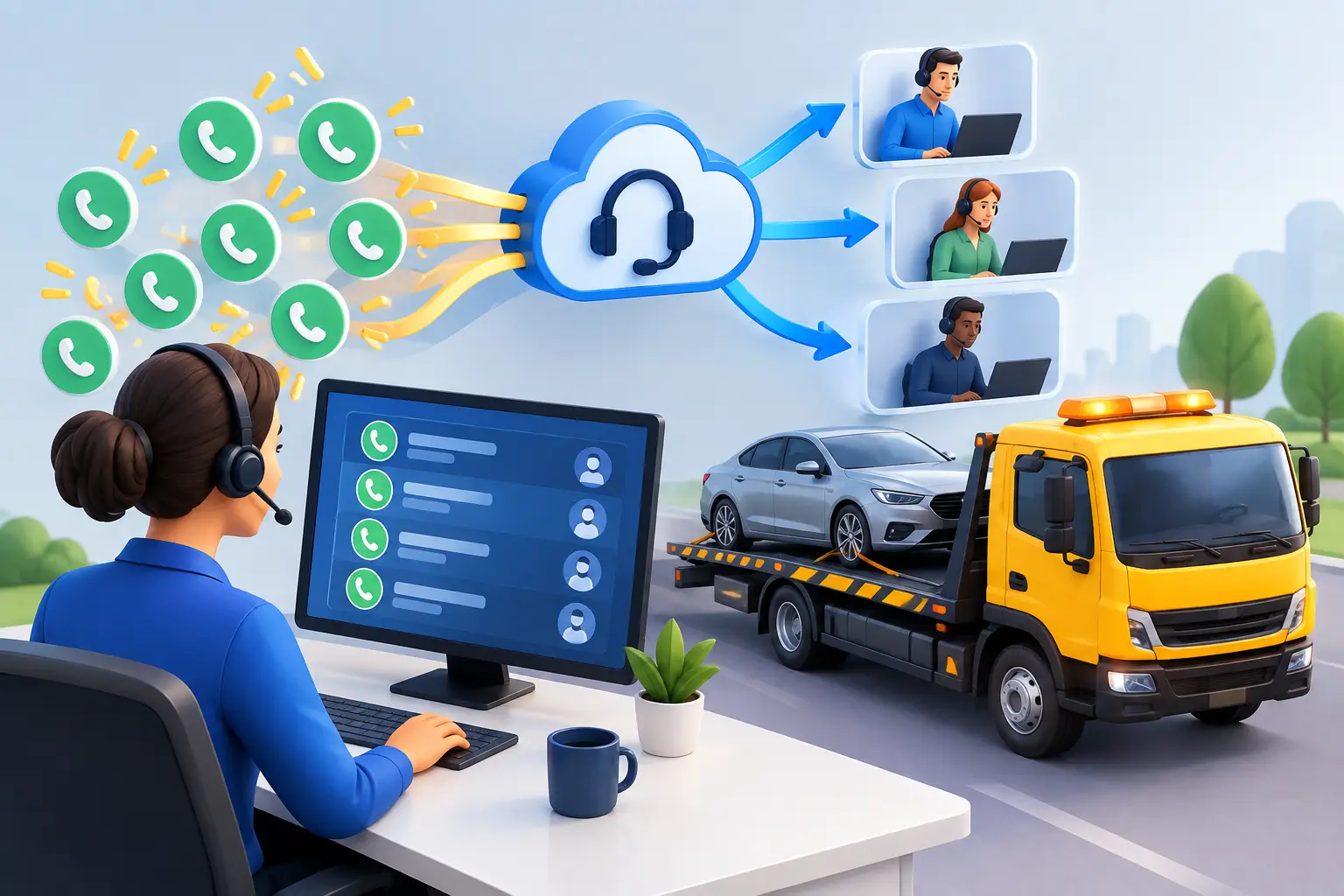
A tow company call overflow solution is not just an answering service for busy periods. It is the operational layer that protects revenue when every dispatcher is on another line, every driver is moving, and the phone keeps ringing. If those calls go to voicemail, a competitor is often one tap away.
For towing operators, overflow is rarely predictable. A storm can hit at 4:30 p.m. A motor club batch can land during shift change. An impound customer may call repeatedly while dispatch is building a complicated roadside job. The question is not whether calls will stack up. It is whether your operation has a controlled process for handling them without slowing down the work already in progress.
Why Call Overflow Becomes a Dispatch Problem
A missed call is visible. The operational damage behind it is harder to see. A customer who cannot reach your company may call another provider. A motor club representative may escalate a job. A vehicle owner may become more frustrated with every transfer or delayed answer. Meanwhile, the dispatcher trying to recover the call queue has less time to enter accurate details, route equipment, update ETAs, and communicate with drivers.
This is why adding another person to answer phones does not always solve the problem. If that person does not understand towing workflows, they can create incomplete tickets, send calls to the wrong queue, or interrupt dispatch with questions that should have been resolved during intake. Cheap overflow coverage can simply move the bottleneck from the phone line to the dispatch board.
The right model preserves three things at once: call capture, job accuracy, and dispatch control. It should allow the operation to handle more inbound volume without forcing managers to choose between customer responsiveness and clean execution.
What a Tow Company Call Overflow Solution Must Handle
Towing calls are not all the same, and routing every caller through a generic script produces generic results. A working overflow process recognizes the difference between a new cash call, a police rotation request, an existing roadside job, an impound inquiry, a motor club status request, and a complaint that needs management attention.
For a roadside customer, the intake flow may require location verification, vehicle details, condition, destination, callback number, and payment or coverage information. For an impound caller, the priority may be confirming the vehicle, explaining required documents, communicating lot hours, and routing release questions correctly. For motor club work, the call may need to be matched to a specific job number, provider process, or service level expectation.
A capable overflow operation should be configured around your rules, not an outside call center’s assumptions. That includes which calls can be fully processed, which calls require a live dispatcher, which jobs should be escalated, and when a manager should be notified. It also includes how to handle service areas, prohibited jobs, specialty equipment, pricing questions, language needs, and after-hours release procedures.
The Difference Between Answering and Owning the Call
Answering within a few rings is only the first requirement. The call needs a clear next step. A caller should not have to repeat their situation when the conversation moves from an overflow agent to your dispatcher. Your team should not have to listen to recordings and rebuild job details after the fact.
That is why integration matters. When intake data moves directly into the workflow your dispatch team already uses, the call becomes an actionable job instead of a message waiting in a queue. For Towbook users, that means the overflow process should support the same operational discipline as an in-house dispatcher: accurate notes, correct customer information, defined service types, appropriate status handling, and visibility for the people running the board.
Automation can speed up repetitive intake, but it should not remove judgment from exceptions. A caller reporting a child locked in a vehicle, a law enforcement request, a disputed tow, or a driver safety concern may need human review immediately. The strongest approach is hybrid: automation handles speed and consistency, while trained towing dispatch support takes ownership when the call requires context.
Build the Call Flow Before You Need It
Overflow coverage fails when it is treated as a switch that turns on only after the phones become unmanageable. By that point, no one has time to decide what should happen to each call type. Build the rules during normal operating conditions, test them, and adjust them based on real call patterns.
Start by identifying when overflow actually occurs. For some companies, it is primarily nights and weekends. For others, the highest risk is weekday peaks, weather events, lunch coverage, or the hour when day dispatch hands off to after-hours staff. Review call logs alongside missed calls, abandoned calls, new-job volume, and job completion times. The goal is to find the moments when your internal team is most likely to lose control of the queue.
Then define how calls are prioritized. A new private-pay tow, a police request, a motor club escalation, and an existing customer asking for an ETA should not necessarily take the same path. Priority rules should reflect revenue, contractual obligations, safety, and customer impact.
A practical call flow answers four questions for every category:
- Who answers the call first?
- What information must be collected before the caller is released?
- Can the job be entered or updated immediately?
- When does the call need to be escalated to your dispatcher or manager?
Those rules should be specific enough that the person or system handling the call does not have to guess. “Send urgent calls to dispatch” is not a rule. “Transfer active police rotation requests to the designated dispatch line, then notify the on-call manager if unanswered after 60 seconds” is a rule.
Measure More Than Missed Calls
Zero missed calls is a strong operational goal, but it does not tell the whole story. A company can answer every call and still lose money if call handling creates duplicate jobs, poor notes, delayed dispatch, or unnecessary transfers.
Track call capture first: answered calls, abandoned calls, callbacks completed, and inbound opportunities that became dispatched jobs. Then look at operational quality. How long does it take from first contact to job creation? How often does a dispatcher have to call back for missing information? How many overflow calls require correction? Are drivers receiving clean notes and correct destinations?
The financial picture matters too. Compare overflow coverage costs with the labor cost of maintaining in-house coverage for every peak and overnight hour. Include revenue recovered from calls that would have gone unanswered, especially private-pay work and high-value service requests. There is no universal break-even point because rates, call mix, staffing costs, and geography vary. But the math becomes clear when you measure captured jobs against the cost of coverage.
A useful benchmark is whether the service gives your core dispatch team more productive time. If experienced dispatchers spend fewer minutes taking routine status calls and more time managing fleet movement, exceptions, driver communication, and complex jobs, the operation is gaining capacity even before adding trucks.
Where AI Helps and Where It Does Not
AI voice handling can be effective for high-volume, repeatable calls. It can answer immediately, gather structured information, identify common intent, and follow established routing rules at any hour. That makes it particularly useful for first-response coverage, after-hours intake, basic impound information, and routine roadside requests.
But towing is full of exceptions. GPS locations can be unclear. Customers may be stressed or angry. A vehicle may be inaccessible, damaged, loaded, or in an unsafe position. A club representative may use language that changes the urgency of a job. Those are not situations to force through a rigid conversation just because automation is available.
The operational standard should be simple: use AI where it reduces delay and improves consistency, then provide towing-trained human support where judgment is needed. Towing Forward is built around that model, combining always-on voice response with human dispatch expertise and rules configured for real towing scenarios.
Avoid the Common Overflow Mistakes
The first mistake is treating overflow as a separate operation. If calls are answered outside your dispatch workflow, information gets stranded and accountability becomes unclear. The second is using overly broad routing rules that flood the on-call dispatcher with calls that could have been resolved during intake.
Another mistake is failing to update the playbook. Lot hours change. Service areas expand. Pricing changes. A new motor club requirement appears. Drivers are added or equipment goes out of service. Overflow instructions must reflect the operation as it exists now, not the operation you had six months ago.
Finally, do not judge coverage only by whether someone picked up the phone. Review recorded outcomes, job accuracy, transfer reasons, escalation frequency, and customer feedback. The goal is not a busier call center. It is a more controlled dispatch operation.
Your phones will not become quieter as the business grows. A disciplined overflow process makes sure higher volume becomes captured work, cleaner jobs, and better fleet utilization instead of another reason for dispatch to fall behind.
Leave a Reply