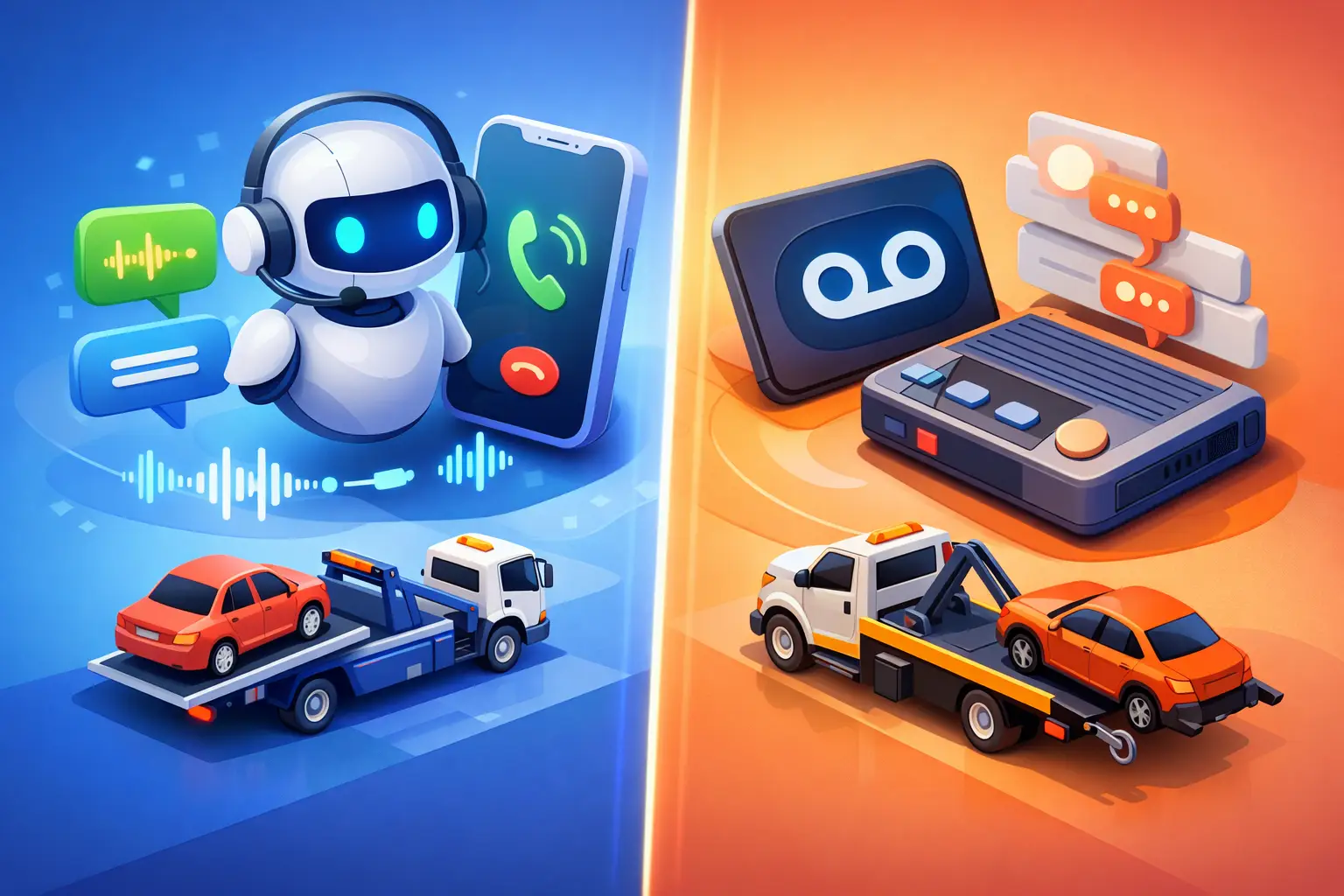
A stranded motorist calling at 2:14 a.m. is not looking to leave a message. A police department calling about an impound release, a motor club checking ETA, or a repeat customer needing a jump-start has the same expectation: someone answers, understands the request, and moves it forward. That is the real operational difference in the AI call answering vs voicemail decision for towing companies.
Voicemail is inexpensive, familiar, and sometimes necessary. But it is not a dispatch workflow. It captures a recording after the caller has already encountered a delay, then requires someone to listen, interpret the request, return the call, and enter the job. AI call answering can turn that same inbound moment into a structured interaction, with the right information captured and the right next action triggered.
For a towing operation managing thin margins, rotating coverage, and unpredictable call volume, the choice is less about new technology and more about call capture, response time, and control.
What Voicemail Actually Costs a Towing Operation
The direct cost of voicemail is close to zero. The operating cost is not. Every message creates a gap between a customer asking for help and a dispatcher taking ownership of the job. During that gap, the caller may contact another company, a motor club may reassign the request, or a vehicle owner may become frustrated before your team has even heard the details.
The problem compounds after hours. A small fleet may route calls to an owner, driver, or shared mailbox to avoid staffing a night dispatcher. That approach sounds efficient until several calls arrive close together. Messages stack up. Details are incomplete. A driver is interrupted while working another scene. By morning, the team is sorting through callbacks rather than starting the shift with a clean queue.
Voicemail also weakens visibility. A recorded message rarely follows a consistent format. One caller provides a plate number but no location. Another gives a highway marker with no callback number. A motorist may describe a vehicle issue without saying whether the car is safely off the roadway. The dispatcher has to reconstruct the job before dispatch can begin.
There are situations where voicemail remains acceptable. A nonurgent office line, a vendor inquiry, or a low-priority after-hours administrative request does not always need live handling. But emergency roadside requests, impound questions, active customer jobs, and motor club calls are revenue and service events. Treating them as recordings creates avoidable friction.
AI Call Answering vs Voicemail: The Workflow Difference
The useful comparison is not automated voice versus a recorded greeting. It is passive message collection versus active call handling.
Voicemail asks the caller to explain their situation and promises that someone may respond later. AI call answering greets the caller, identifies the reason for the call, collects the required details, and follows routing rules built around your operation. For a roadside request, that can mean gathering the pickup location, vehicle information, requested service, destination, safety context, and callback number. For an impound caller, the system can collect identifying details and route the request based on your release process.
That structure matters because towing calls are not interchangeable. A complaint should not take the same route as a police rotation call. A customer looking for a vehicle release may need hours, documentation requirements, and a human escalation path. A motor club request may require a specific workflow and priority. AI is valuable when it recognizes those call types and moves each one according to rules you control.
The best systems do not force every caller through an inflexible script. They combine defined intake questions with escalation logic. If a caller is confused, upset, reporting a safety concern, or needs an exception, the call should move to a trained human who understands towing operations. Automation handles repeatable work. Human support handles the judgment calls.
Why Live Capture Changes Revenue and Response Time
A completed call is not automatically a captured job. The job must be documented correctly, routed quickly, and visible to the people who need to act on it. This is where an AI answering system can create a measurable operational advantage over voicemail.
First, it reduces abandonment. Callers are more likely to stay engaged when they hear a responsive voice that can help immediately rather than a generic request to leave a message. That is especially true when they are on a busy shoulder, outside a closed business, or trying to resolve an impound issue before a deadline.
Second, it reduces callback time. With voicemail, the clock starts after the message ends and continues until someone notices it. With AI answering, intake begins while the caller is still on the line. A well-designed workflow can send a structured request into the dispatch process immediately, rather than requiring a dispatcher to replay audio and chase missing information.
Third, it improves job quality. Consistent questions produce more consistent records. That means fewer follow-up calls, fewer location errors, and less back-and-forth between the dispatcher and driver. If your operation uses Towbook, the value increases when call details can flow into the system and support the workflow your team already runs instead of creating another inbox to monitor.
The result is not simply faster phone coverage. It is a cleaner handoff from call to dispatch.
The Towing Scenarios That Need More Than a Message
Not all incoming calls carry the same urgency, but several towing scenarios almost always benefit from live handling.
Roadside assistance calls need location confirmation and a clear understanding of the service requested. A vehicle that needs a tire change, fuel delivery, lockout, jump-start, or tow may require different equipment, pricing, or driver assignment. Waiting for a callback adds time before the company can make those decisions.
Impound and private-property calls require process discipline. Callers often have questions about vehicle location, release hours, accepted payment, required documents, or personal-property access. An answering system should provide approved information where appropriate and send exceptions to the right human team member. It should not guess, overpromise, or expose information outside your rules.
Motor club work has its own requirements around coverage, priority, status updates, and data accuracy. A missed or delayed motor club call can affect more than a single job. It can damage a relationship that produces recurring volume.
Complaint calls deserve care as well. A voicemail may preserve the caller’s words, but it does nothing to de-escalate the situation. A trained call handler can acknowledge the concern, capture the facts, and route it to the correct manager with context. That protects both customer experience and accountability.
Where AI Call Answering Has Limits
AI call answering is not a substitute for operational design. If your routing rules are unclear, rate information is inconsistent, or dispatch ownership is undefined, the technology will expose those weaknesses rather than fix them.
It also should not operate without escalation paths. Towing involves distressed customers, law enforcement interactions, complex releases, damage concerns, and unusual scenes. A system that tries to automate every conversation can create risk. The practical model is one that resolves routine requests quickly and brings in experienced people when a call requires judgment, empathy, or authority.
Implementation quality matters too. A generic answering platform may capture a name and phone number, but that is not enough for towing. Your setup needs service-area logic, business-hour rules, after-hours rules, impound procedures, motor club routing, driver or dispatcher escalation, and clear ownership for every call type. It should reflect how your company actually runs, not how a generic call center assumes it runs.
How to Evaluate the Right Option
Start with your missed-call data, not a vendor demo. Review how many calls hit voicemail, how long it takes to return them, how often messages lack critical information, and how many potential jobs disappear before a callback. Separate daytime volume from overnight and weekend traffic. The answer may be different for each coverage window.
Then map the calls that create the most operational value or risk. For many fleets, those are roadside jobs, motor club requests, police or property-manager calls, impound inquiries, and active customer status calls. Define what information must be captured, what should be entered into Towbook, who owns the next step, and when a human must take over.
Finally, measure the outcome after implementation. Watch answered-call rate, abandonment rate, average time to job entry, callback time, jobs created from inbound calls, after-hours staffing expense, and complaint resolution time. An AI answering service should be accountable to those operational results, not just the number of minutes it handled.
Towing Forward is built around this hybrid standard: always-on AI intake paired with towing-specific human support, custom call routing, and Towbook-centered workflow discipline. The goal is not to make your phones sound automated. It is to keep calls from becoming loose ends.
Your callers do not experience your staffing plan, software stack, or overnight schedule. They experience the first response. Build that response so the next towing job enters your operation with the information, urgency, and ownership it deserves.
Leave a Reply