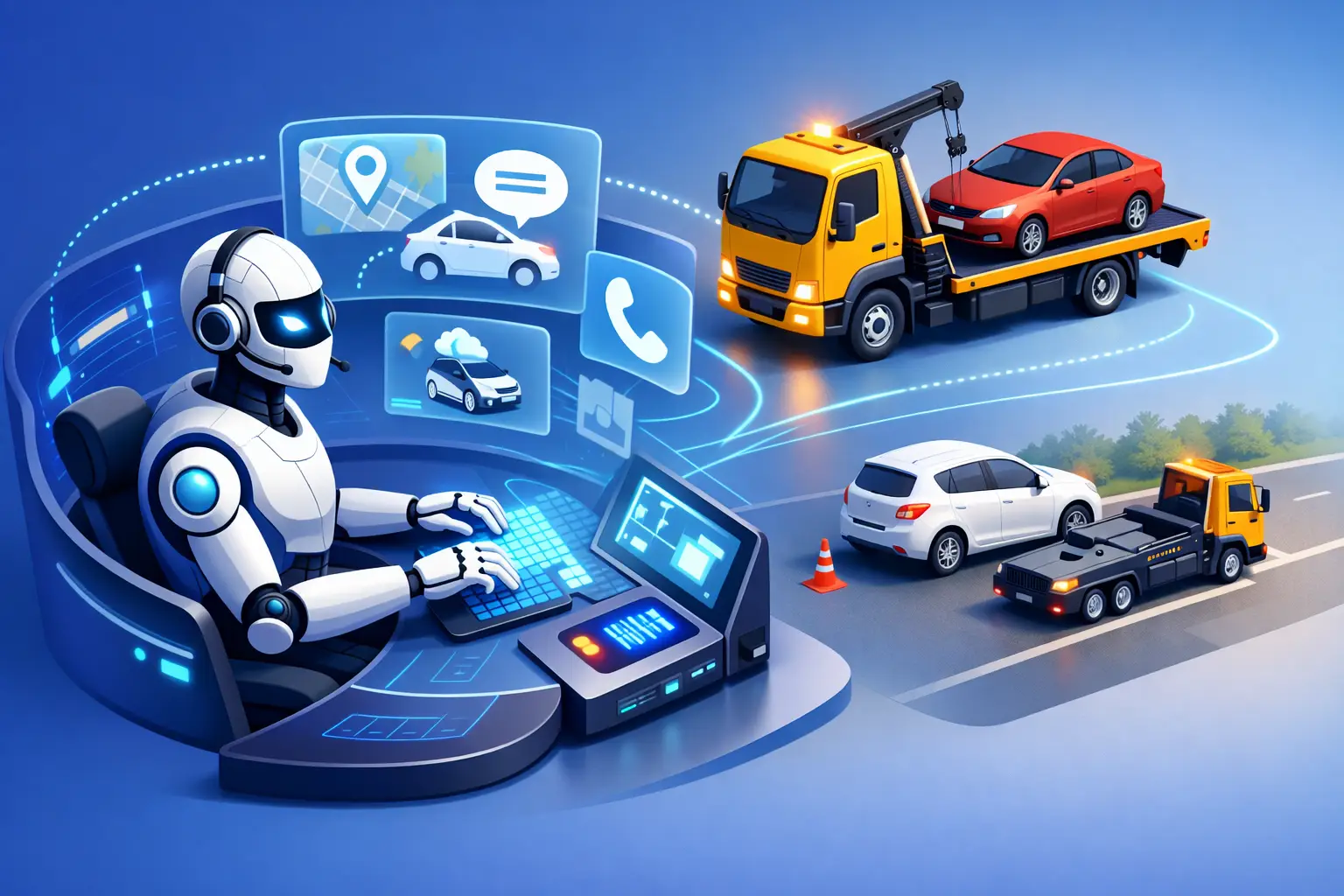
A vehicle owner calls at 2:17 a.m. with a flat tire on a dark interstate shoulder. Another caller wants to know whether their impounded car is available for release. A motor club needs an ETA update. The phone cannot ring out while your only overnight dispatcher is tied up on a difficult recovery. So, can AI answer towing calls? Yes, when it is built around the actual rules, workflows, and escalation points of a towing operation.
The more useful question is not whether an AI voice agent can speak with callers. It can. The question is whether it can collect the right information, apply your dispatch rules, move the job into the right workflow, and recognize when a trained human needs to take over. That is the difference between a novelty answering service and an operating system for call capture.
Can AI Answer Towing Calls Reliably?
AI can reliably handle a large share of repetitive, structured inbound towing calls. That includes new roadside requests, basic service questions, impound-lot information, motor club call intake, ETA requests, after-hours messages, and calls that need to be routed to a particular department or on-call employee.
For a straightforward roadside call, the AI should confirm the caller’s name and callback number, vehicle description, exact location, service needed, destination if applicable, and any safety-critical details. It should ask whether the vehicle is in a safe location, whether keys are available, and whether there are access issues such as a parking garage, low clearance, or a locked gate. The goal is not to make conversation. The goal is to create a dispatch-ready job with fewer follow-up calls.
Reliability depends on configuration. A generic agent may understand the words “tow truck,” but it will not know your service area boundaries, which trucks handle motorcycle tows, how you prioritize police rotation work, or what information your impound release process requires. Towing call automation must be trained and routed around your business, not a generic call-center script.
What AI Is Good At in a Towing Dispatch Workflow
The strongest use case is protecting call capture when the phones are busiest or least staffed. AI does not get distracted by a radio call, stop answering after a long shift, or place a caller on hold because three other lines are ringing. It can answer immediately, follow the same intake process every time, and document the interaction.
That consistency matters because missed calls are rarely just missed revenue. They can mean a stranded customer calling a competitor, a motor club job lost to nonresponse, an impound customer escalating a complaint, or a dispatcher spending the next morning reconstructing incomplete notes.
When connected to Towbook or a comparable dispatch workflow, AI can do more than take a message. It can collect job details in a structured format, create or update the right record, apply predefined routing logic, and notify the appropriate person or queue. The dispatcher starts with usable information instead of a voicemail that says, “Need a tow, call me back.”
AI is also effective at handling predictable questions. If your impound procedures, business hours, accepted payment methods, release requirements, and lot address are clearly defined, callers can get accurate answers without tying up a dispatcher. The same applies to basic ETA status when the available data supports it.
Where Human Dispatch Still Matters
Not every call should be automated from start to finish. Towing is not a simple appointment-booking business. Calls can involve safety concerns, police departments, damage complaints, disputed charges, vehicle-release exceptions, emotional customers, unclear locations, or complex recovery requirements.
A good system knows when to stop automating and escalate. If a caller reports an injury, immediate danger, a blocked roadway, an active accident scene, or a situation that requires emergency services, the AI should follow your emergency protocol and quickly involve the right human resource. It should never create the false impression that it is a substitute for 911 or law enforcement.
Human judgment is also essential when the details do not fit the rules. A customer may have a vehicle with extensive damage, a dual-wheel truck in a restricted-access lot, an EV with unknown transport requirements, or a complaint that could become a chargeback. These are not failures of AI. They are the exact situations where escalation protects your company, your drivers, and the customer experience.
The practical model is hybrid: automation manages volume and routine intake, while trained dispatch professionals handle exceptions, sensitive calls, and decisions that require context. This keeps humans focused where they add the most value instead of using their time to repeat addresses, business hours, and standard intake questions.
The Rules That Make AI Call Answering Work
Before deploying AI, document the decisions your best dispatcher makes without thinking. Those decisions become routing rules, prompts, escalation triggers, and data requirements.
Start with call categories. A roadside request, private-property impound inquiry, motor club assignment, police call, payment question, and complaint should not enter one generic path. Each needs its own questions, permissions, routing destination, and service-level expectation.
Next, define service-area logic. The system needs to know where you operate, which areas require approval, where after-hours pricing or special equipment may apply, and when to transfer a call rather than promise service. It should not quote, dispatch, or accept a job beyond the rules you have approved.
Then establish escalation rules. Identify the phrases and conditions that require immediate human attention: injury, unsafe location, law enforcement, vehicle damage dispute, frustrated caller, unclear location, a request for a supervisor, or any job that does not meet the required information standard. Clear escalation is a control mechanism, not an afterthought.
Finally, decide what gets written into the job record and what gets communicated to the driver. Dispatchers and drivers need concise, useful information. Long transcripts are less valuable than verified callback details, location, service type, vehicle information, destination, payment or authorization status, and relevant access notes.
Accuracy Depends on Better Intake, Not Better Hype
Voice AI can mishear a street name, confuse a vehicle model, or encounter a caller who is stressed and speaking quickly. Human dispatchers can make those same mistakes. The difference is how the workflow catches them.
Critical fields should be confirmed. The caller’s callback number, pickup location, destination, and vehicle type deserve a read-back or direct verification step. For highway calls, location collection should account for mile markers, travel direction, exits, landmarks, and GPS links where your process supports them. “Near the Walmart” is not a dispatch location.
Your team should also review real calls regularly. Look for abandoned calls, transfers, repeat questions, corrections made by dispatchers, unserviceable requests, and calls that took too long. Those findings should drive adjustments to prompts and routing rules. An AI deployment is not a one-time phone installation. It is an operational process that improves through call-level visibility.
Measure the Outcomes That Affect Margin
The right metrics are operational, not theatrical. A high percentage of calls answered means little if callers cannot get help or jobs arrive with missing information.
Track answer rate, abandoned-call rate, time to answer, completed intake rate, transfer rate, and the percentage of jobs that need correction before dispatch. Compare after-hours call capture before and after implementation. Review booked jobs, motor club response performance, and dispatcher labor hours alongside customer complaints and repeat-call volume.
The financial case often becomes clear during nights, weekends, peak weather events, and staff shortages. If automation prevents calls from rolling to voicemail and reduces the number of full overnight staffing hours required, it can improve margin while protecting response standards. But cost reduction should not come from removing oversight. It should come from directing human effort toward complex, high-consequence work.
A Controlled Rollout Beats an All-or-Nothing Switch
Start with a narrow scope, such as after-hours roadside intake or overflow calls during daytime peaks. Use a limited set of service types, clear transfer conditions, and a review period with real call recordings and job outcomes. This exposes gaps without putting your entire dispatch operation at risk.
Once the workflows are accurate, expand into additional call categories. Towing Forward applies this approach through towing-specific voice handling, custom routing rules, Towbook-connected workflows, and human support when a call needs more than automation can safely provide.
The standard should be simple: every caller gets an answer, every job gets the information needed to act, and every exception reaches a person who has authority to resolve it. When those controls are in place, AI does not replace dispatch discipline. It gives disciplined towing companies more of it, even when the phone starts ringing after everyone else has gone home.
Leave a Reply